
Aging is a lot like foreign travel. You don’t know what to expect until you get there.
As a 63-year-old endurance athlete who has logged tens of thousands of miles on my bike, I’ve watched my body change over the decades. I anticipated that maximum power output and endurance would diminish over time. What surprised me was how much longer recovery would take.
As a teenager, I rode hard day after day with no consequences. By middle age, I felt the effects the next morning. Now I feel a hard ride two days later.
This shift has changed my approach to training. Recovery now demands as much attention as the training stimulus itself. The fundamentals matter: adequate sleep, fluid intake, calorie and protein targets, stretching, and core strength to protect the spine, joints, and muscles.
In the context of better recovery, urolithin-A caught my attention. My experience taking it for several months, along with the supporting research, has convinced me this compound deserves more attention from those pursuing athletic performance after 50.
The Research on Urolithin-A
Two double-blinded, placebo-controlled randomized trials drew my attention. They studied different populations and produced consistent findings.
A 2025 study in Sports Medicine followed elite male runners with an average age of 27 through a four-week high-altitude training camp. The group taking urolithin-A showed reduced muscle inflammation and improved markers for mitochondrial function. In a 3K timed run, those on urolithin-A reported a lower rate of perceived exertion without faster times: same speed, less pain.
A 2022 study in JAMA Network Open followed older men and women with an average age of 72 over four months. Participants on urolithin-A showed improved muscle endurance and reduced muscle inflammation. The six-minute walk distance, a common functional marker in geriatric research, did not change.
The geriatric result echoes the runner finding: same distance, less muscle fatigue. Together, these studies support the concept that urolithin-A improves recovery even when peak performance stays the same.
My Personal Experience With Urolithin-A
For me, the research lined up with a real-world test on my own body.
Several months into taking urolithin-A, I noticed I could do the same bike rides and feel less sore and depleted the next day. At my age, that counts as a win. The running joke around my house is, “Oh my god, I feel like a 55-year-old again.”
When you’re 63, feeling like a 55-year-old is a win. This kind of recovery support fits the broader picture of exercise as the fountain of youth: small daily edges compound into meaningful longevity gains.
What Is Urolithin-A? Why Supplementation Matters
We’ve evolved in a symbiotic partnership with our gut bacteria. It’s a team sport, with us as the hosts and our gut microbes producing compounds we need.
When we eat ellagitannins, compounds in pomegranates, walnuts, strawberries, raspberries, and other berries, beneficial gut bacteria such as Enterocloster and Gordonibacter species break them down. The byproduct is urolithin-A.
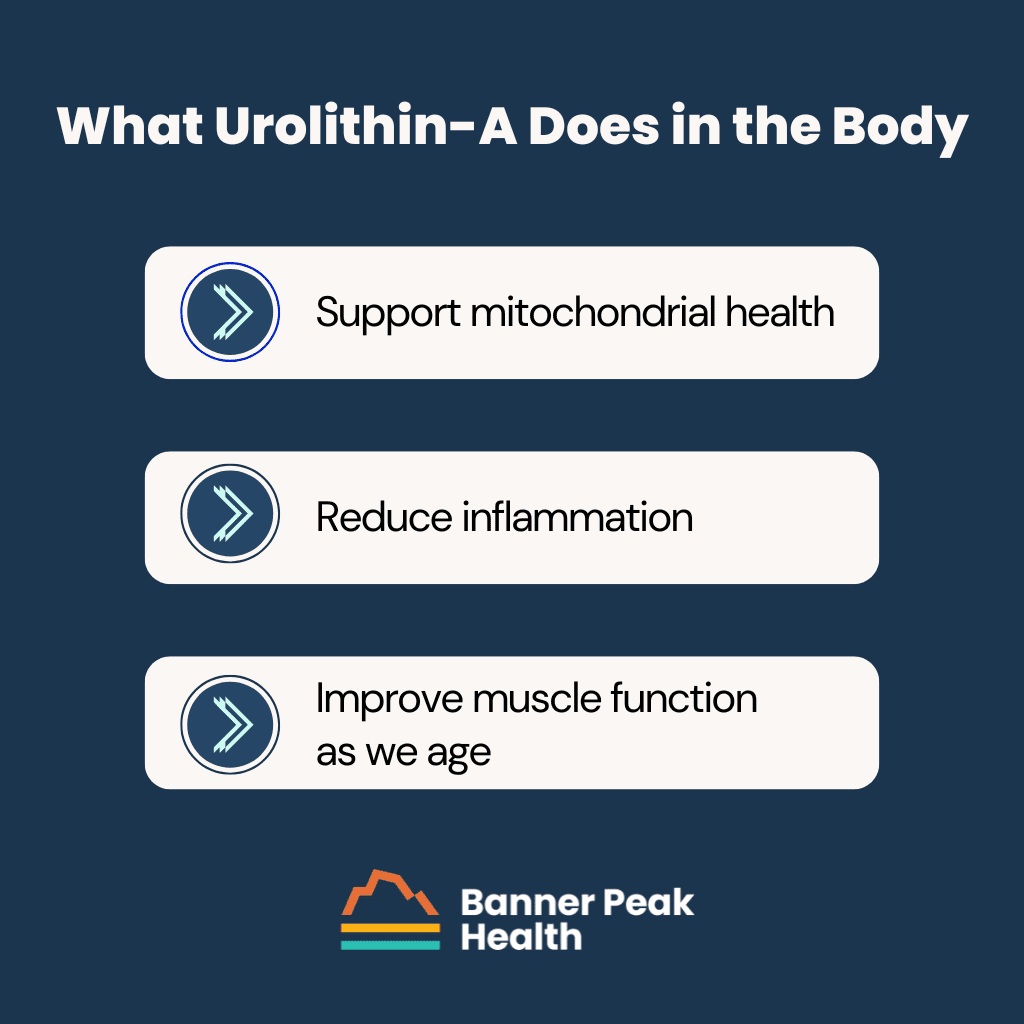
Urolithin-A appears to support mitochondrial health, reduce inflammation, and improve muscle function as we age.
The reason supplementation matters comes down to gut bacteria distribution. When researchers measure urolithin-A production in subjects who eat ellagitannin-rich foods, up to 50% of people don’t produce enough urolithin-A from food alone. Supplementation closes the gap for those individuals.
Anyone curious about how gut microbes shape our health will find more in our guide to prebiotic supplements and gut health.
How Urolithin-A Activates Mitophagy
To understand urolithin-A, we need to understand mitochondria, the tiny power plants inside almost every cell. Mitochondria convert food energy into ATP, the fuel for every system that keeps us alive and moving.
As we age, mitochondria become less efficient and accumulate damage. Cells produce less energy, generate more waste, and the cumulative effect contributes to fatigue, muscle weakness, and age-related decline.
The body has a built-in quality control process called mitophagy: identifying, eliminating, and replacing damaged mitochondria with healthy new ones. Picture a country’s electrical grid. Replace the worn-out plants with newer ones, and the entire system generates more power.
Urolithin-A is one of the most potent natural activators of mitophagy we’ve identified. It appears to stimulate the replacement of worn-out mitochondria with new, healthy ones. The decline in mitochondrial function helps explain why VO2 max declines with age and why supporting mitophagy matters for aging athletes.
Additional Urolithin-A Benefits
Beyond muscle endurance and recovery, urolithin-A shows benefits across several inflammation and metabolic markers. Trial participants taking the compound have shown reduced levels of C-reactive protein, a standard inflammation marker measurable through blood tests.
Other biomarkers tied to mitochondrial health improve under supplementation. Ceramides and acylcarnitines drop with supplementation. Both are blood markers researchers use to assess mitochondrial function from the outside.
These biochemical improvements suggest urolithin-A is working at the cellular level even when functional benchmarks haven’t shifted. The pattern mirrors how the vagus nerve calms inflammation: biological signals shift first, function follows.
What to Know Before Trying Urolithin-A
Clinical trials typically use 500–1,000 milligrams of urolithin-A per day. Studies have reported no serious side effects up to 2,500 milligrams daily, and the compound holds GRAS status, the FDA’s safety designation for established food ingredients.
Like all supplements, urolithin-A products differ in purity and formulation across brands. The brand I take is Mitopure, the same formulation used in most randomized controlled trials.
Mitopure synthesizes the molecule directly rather than fermenting ellagitannins with bacteria. The direct route yields a purer, more reliable product.
Recent studies have used 1,000 milligrams per day, so I recommend the 500-milligram tablets to hit that urolithin-A dose. A note on the brand options: A company called Timeline sells 250-milligram tablets dosed twice daily, which reaches only 500 milligrams. Mitopure manufactures Cellular Longevity Pro in 500-milligram tablets, 60 per bottle, which delivers 1,000 milligrams daily.
The product carries GRAS status, Clean Label Project certification, and NSF Certified for Sport. The last matters for competitive athletes, since NSF certification verifies a supplement contains no substances banned by sports federations. For broader guidance, see our work on safe choices with supplements.
Today’s Takeaways
For aging athletes especially, urolithin-A appears to be a worthwhile addition to the recovery toolkit. Two well-designed trials show reduced muscle inflammation and improved mitochondrial markers, albeit without a change in peak performance. My own experience matches the research, and at 63, I’m taking urolithin-A daily.
Three points sum up the case for the compound. About half of us can’t make enough of it from diet alone. Mitochondrial health declines with age, and the data so far shows a clean safety profile alongside growing biochemical support.
If you’ve been thinking about supporting recovery as you age, urolithin-A is worth a conversation. At Banner Peak Health in Walnut Creek, we track the literature on emerging tools like this one, alongside fundamentals like resistance training for longevity. To discuss whether urolithin-A fits your goals, reach out to our practice.