

What do the United States, Liberia, and Myanmar have in common? They’re the only three countries on the planet that don’t use the metric system.
The rest of the world’s 7.85 billion people measure in meters and kilograms. We’re still using the U.S. customary system, a clunky relic in which 12 inches equal one foot and 5,280 feet equal a mile.
Our system isn’t better. The metric system is simpler, more logical, and universally adopted. But we stay the course out of inertia: it’s the way we’ve always done it, and the effort to change feels too large.
The situation in cardiovascular medicine is strikingly similar. American physicians continue to rely on LDL cholesterol (LDL-C) as the primary treatment target for coronary artery disease, even though a more accurate marker, apolipoprotein B (ApoB), has been available for years.
The Europeans have already made the switch. We’re still debating it.
Europe vs. America: A Guideline Gap
As early as 2019, the ESC and EAS dyslipidemia guidelines stated that ApoB was “a more accurate marker of cardiovascular risk than LDL-C.” They provided specific ApoB treatment targets.
By contrast, the 2018 ACC/AHA cholesterol management guidelines mentioned ApoB only as a “risk-enhancing factor to consider in borderline patients,” with no specific treatment targets or recommendations.
Fast forward to 2026: the ACC/AHA dyslipidemia guidelines have given ApoB greater prominence, but the recommendations remain almost entirely built around LDL and non-HDL-C as primary targets.
The U.S. lags behind Europe in formally adopting the ApoB test as a treatment target, and the delay costs patients early detection of cardiovascular risk. The reasons mirror the metric system problem: decades of randomized controlled trials used LDL-C as the endpoint, clinical workflows are built around LDL targets, and switching requires more effort than staying the course.
What ApoB Is and Why It Matters
Apolipoprotein B (ApoB) is a protein that sits on the surface of every lipoprotein particle in your blood containing potentially hazardous cholesterol: LDL, VLDL, IDL, and Lp(a).
Exactly one ApoB molecule sits on each particle. That means measuring ApoB counts the exact number of dangerous particles circulating in your bloodstream.
Picture two highways (your arteries). Highway A has 100 large trucks, each carrying a heavy load of cargo (cholesterol). Highway B has 200 smaller sedans, each carrying a lighter load. If you measure only the total amount of cargo on each highway, the two might look equivalent.
But Highway B, with twice as many vehicles, has a much higher probability of fender benders: collisions where the contents spill into the vessel walls. That spillage, cholesterol being absorbed into artery walls, is the disease process of atherosclerosis.
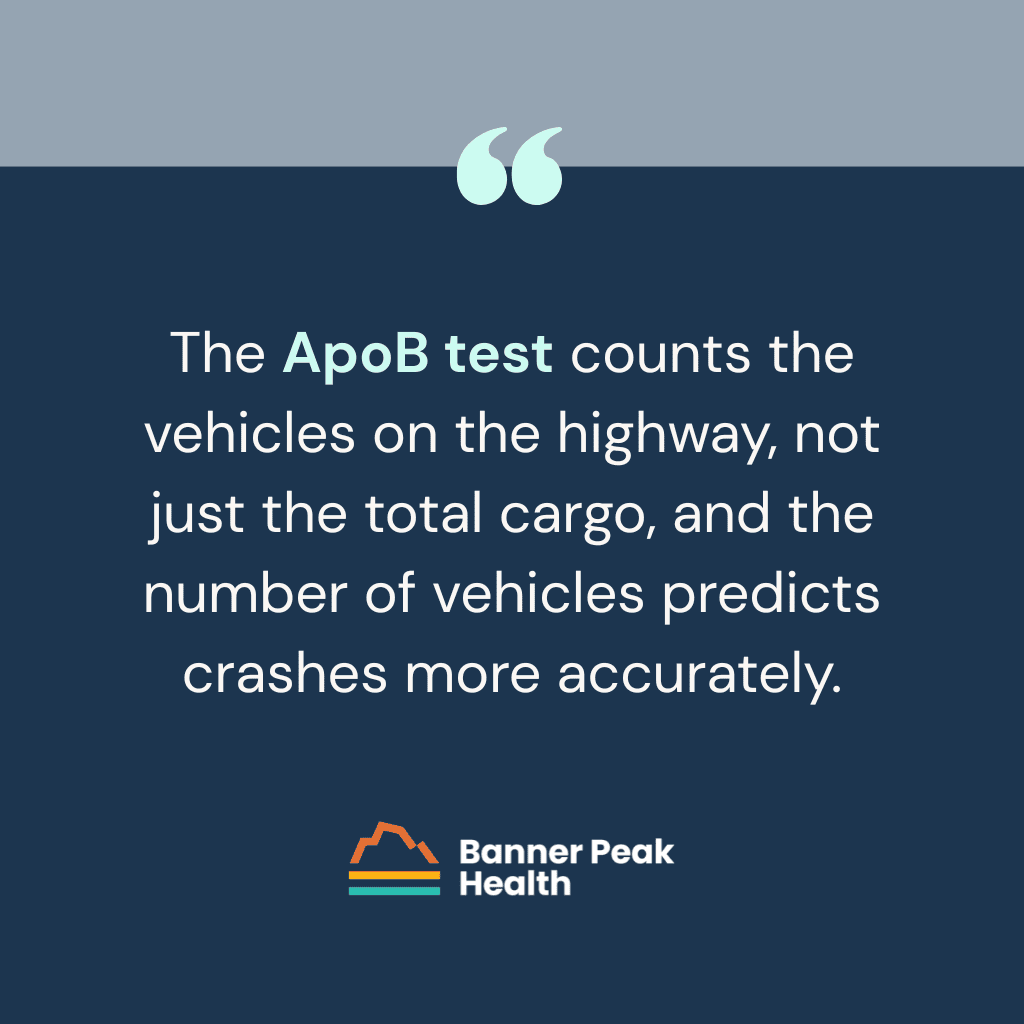
The ApoB test counts the vehicles on the highway, not just the total cargo, and the number of vehicles predicts crashes more accurately. Cholesterol isn’t inherently dangerous.
It performs normal physiologic functions throughout the body. The danger arises when lipoprotein particles crash into vessel walls and deposit their cholesterol where it doesn’t belong.
Four Reasons the ApoB Test Is the Better Marker
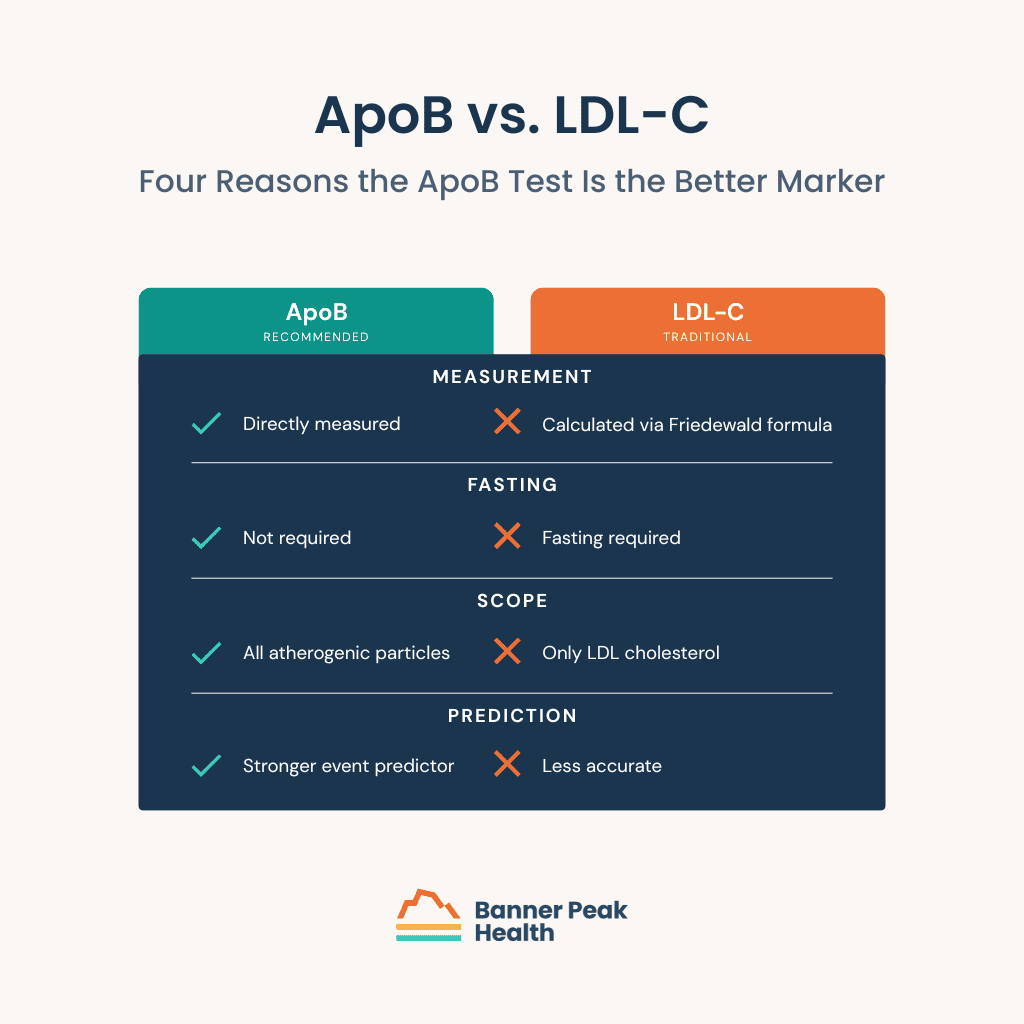
First, ApoB is directly measured. LDL-C is calculated from other values using an equation (the Friedewald formula), introducing a source of mathematical error. A direct measurement is more precise.
Second, ApoB doesn’t require fasting. The LDL-C calculation does. This sounds trivial, but it affects how reliably patients get tested. Fasting requirements create compliance barriers that reduce testing frequency.
Third, ApoB captures all atherogenic particles in a single number. LDL-C reflects only the cholesterol within LDL particles, an incomplete accounting. The cholesterol distributed across VLDL, IDL, and Lp(a) particles goes uncounted; ApoB catches them all.
Fourth, the ApoB test is a stronger predictor of cardiovascular events than LDL-C. It more accurately identifies who will have a heart attack. That’s the metric that matters most.
What Your ApoB Number Means
When you get your ApoB results, you’ll receive a number measured in milligrams per deciliter (mg/dL). Interpreting that number requires the same nuance we’ve discussed in the context of other lab values like hemoglobin A1C: “normal” and “optimal” aren’t the same.
Some labs report ApoB as normal at levels ranging from 120 to 130 mg/dL. That range isn’t healthy. In a society with widespread hyperlipidemia, average is not a target to aim for.
Optimal ApoB levels fall below 90 mg/dL for most adults and below 80 mg/dL for individuals at high cardiovascular risk, including those with diabetes, chronic kidney disease, strong family history, or evidence of early heart disease.
This gap between “normal” and “optimal” has particular clinical relevance for patients with certain metabolic profiles. When HDL runs normal-to-low and triglycerides run normal-to-elevated, a constellation seen in insulin resistance, prediabetes, type 2 diabetes, metabolic syndrome, and obesity, LDL-C becomes less accurate as a risk predictor. ApoB remains reliable.
The numbers are striking: 50–60% of U.S. adults have one or more of these metabolic risk factors. That means roughly half of American adults have a lipid metabolism profile in which LDL-C alone can be misleading.
Getting an ApoB Test
Some physicians don’t order the ApoB test. It isn’t new, expensive, or hard to obtain.
The barrier is the same clinical inertia that keeps us off the metric system. EHR order sets, quality metrics, prior authorization algorithms, and decades of habit all revolve around LDL-C.
It’s a standalone blood draw available at any major commercial lab. It costs $15 to $30, doesn’t require fasting, and produces a single number that has greater predictive value than the traditional lipid panel. The rate-limiting step is the physician’s awareness of the test.
If your doctor doesn’t order an ApoB test, ask for it. At an annual executive health screening or a routine visit, adding ApoB to the lab order takes seconds and can change the trajectory of your cardiovascular care.
Today’s Takeaways
The ApoB test is the cardiovascular equivalent of adopting the metric system: a more accurate, more practical measurement that the rest of the developed world has already embraced. The U.S. is catching up, but inertia is slow to overcome.
If you have a lipid panel that looks “normal” but carries metabolic risk factors, an ApoB result might tell a different story. If you’re already managing cardiovascular risk with lifestyle changes and medication, ApoB provides a sharper lens for evaluating your progress.
At Banner Peak Health, we include ApoB in our standard cardiovascular risk assessments. We continue to evaluate and implement advanced diagnostic tools to reduce coronary artery risk.
But don’t worry: we’ll still discuss your weight in pounds and not kilograms, if that’s what you prefer.
Contact Banner Peak Health to discuss ApoB testing and your cardiovascular risk profile.