

About Our Guest Expert: Angela Stanford, MBA, RDN, is a registered dietitian, integrative nutritionist, and board-certified health and wellness coach. As the owner of Vital Nutrition and Wellness, Angela educates and empowers her clients with the tools to adopt healthier eating and lifestyle habits. Whether working with individuals or groups through coaching programs and worksite wellness programs, Angela inspires people to eat with confidence and take charge of their health.
Many of our patients want the benefits of fasting but find it too difficult to sustain. A traditional water-only fast (three or more days with no food) can trigger powerful cellular repair, but the hunger, fatigue, and disruption to daily life make it impractical for most people.
This has led to growing interest in the fasting-mimicking diet, a protocol designed to deliver the same cellular benefits with less restriction and discomfort.
What Is the Fasting-Mimicking Diet?
The USC Longevity Institute’s Valter Longo, PhD, developed the fasting-mimicking diet (FMD). Longo’s research focuses on cellular repair and longevity, and his research’s central question was, “Can we trigger the body’s fasting response without eliminating all food?”
The answer, based on his research, is yes. By controlling the composition and quantity of calories over a five-day period once a month (low protein, low carbohydrate, high in healthy fats), the FMD tricks the body into activating the same cellular repair pathways as a true water fast.
To understand why this works, it helps to understand what happens at the cellular level during fasting.
How the Fasting-Mimicking Diet Works: Catabolism, mTOR, and Autophagy
Our bodies shift between two states at all times:
- Anabolism is the building state: muscles grow, cells multiply, mitochondria generate energy, and fuel gets stored. Growth hormone, exercise, protein intake, and a protein called mTOR all drive anabolism.
- Catabolism is the opposite: conserving energy, cleaning up cellular waste, and building stress resistance. For the body to do its deepest repair work, it needs to shift into this catabolic state.
Fasting is one of the most effective ways to flip that switch. When calorie intake drops low enough for long enough, the body downregulates mTOR and activates a process called autophagy.
Think of your cell as a factory. Supplies come in, products go out, mitochondria generate power, and DNA directs operations. But if no one ever takes out the trash, the factory floor fills with debris: worn-out organelles, damaged proteins, and cellular waste.
The machinery can’t function at full capacity. Autophagy is the cleanup crew. During fasting, the cell redirects energy toward clearing accumulated waste, a process associated with slower aging, reduced inflammation, and protection against neurodegenerative disease.
A second benefit: During the refeeding phase after a fast, cells appear to use incoming nutrients with greater efficiency, which may stimulate immune renewal through stem cells. The science here is still emerging, but the early data look promising.
The third benefit, and the one with the strongest research behind it, is metabolic reset: reduced insulin resistance, less visceral fat and belly fat (shrinks the waistline), and improved metabolic markers across the board.
What Does the Research Say About the Fasting-Mimicking Diet?
The most notable FMD study appeared in 2017 in Science Translational Medicine. Longo conducted his earlier work in mice, but this study enrolled 100 human participants and tracked outcomes over three monthly cycles of the FMD protocol.
After three months, participants showed reduced fasting glucose, reduced insulin, lower IGF-1 (a growth factor linked to cellular proliferation and cancer risk), reduced visceral fat with preserved lean mass, and lower inflammatory markers like CRP.
The fasting-mimicking diet delivered its clearest results for participants who entered the study with existing metabolic risk factors, a pattern consistent with what we see in clinical practice. Ongoing trials are now exploring potential benefits for cardiovascular disease, autoimmune disease, and cancer therapy. These areas are still early-stage, but the metabolic evidence is solid.
The Fasting-Mimicking Diet Is a Tool, Not a Hack
Angela Stanford, our collaborating dietitian, puts it well: “For long-term change, there’s no hack. There’s science, and there’s protocol.”
The fasting-mimicking diet is a tool within a broader lifestyle strategy, not a five-day fix that lets you eat cheeseburgers the rest of the month. The protocol includes those five days of structured eating, and it’s designed to influence your habits over the other 25 days, too.
Angela sees this play out with patients at Banner Peak Health. After completing a round of FMD, people feel better, see improved lab results, and carry that momentum forward.
They start walking for their daily steps. They move their bedtime up. They sign up for a yoga class. The FMD becomes an entry point that triggers a cascade of positive changes.
This is one area where the fasting-mimicking diet differs from both intermittent fasting and extreme water fasts. True intermittent fasting, the alternate-day version (eat Monday, fast Tuesday, eat Wednesday, fast Thursday), is difficult to maintain alongside a modern work and family schedule. Long-term extreme caloric restriction tends to create a pendulum effect: severe restriction followed by overcorrection.
The fasting-mimicking diet sits in a more practical middle ground.
A deeper distinction between the fasting-mimicking diet and time-restricted eating: The cellular benefits of fasting (autophagy, in specific) don’t kick in until day two or three of sustained caloric restriction. A 16-hour daily fast may not reach that threshold. By eating again the next morning, you interrupt the catabolic shift before the cell’s cleanup mechanisms engage.
It’s like cleaning your house: You can tidy up every day (time-restricted eating), but a deep clean (the five-day FMD) clears out the accumulated mess in a way daily maintenance can’t. And once the house is clean, most people are more motivated to keep it that way.
The Fasting-Mimicking Diet Food List and Protocol Structure
The fasting-mimicking diet protocol calls for whole, plant-based foods eaten within a 12-hour window. The macronutrient breakdown targets low carbohydrates, around 10% protein, and a high proportion of high-quality fats. Hydration is a priority throughout.
The calorie structure breaks down like this: about 1,100 calories on day one, then 700 to 800 calories on days two through five. These numbers are starting points.
Angela emphasizes the need for individual fine-tuning, which is why working with a dietitian matters. A six-foot-two active man and a five-foot-one woman recovering from an injury need different calorie targets to hit the metabolic sweet spot.
A typical fasting-mimicking diet food list includes vegetable broths, nuts, avocado, low-glycemic fruits like berries, and salads with simple dressings (lemon juice, olive oil). The menu is limited, but most patients tolerate it well.
What about hunger? Angela reports most patients don’t complain. During the first cycle, some notice mild cold sensitivity and lower energy.
By the second and third cycles, patients are walking outdoors during their fast days and returning to yoga and other regular exercise. The body adapts.
The standard protocol is once a month for three consecutive months. After that, the frequency depends on individual goals and health status.
A healthy person might continue two to three times a year. Someone working to lower their hemoglobin A1C and blood sugar or reduce visceral fat around the belly might continue monthly under medical supervision.
One note on supplements and medications: The FMD alters your metabolic state. Consult your physician or dietitian before starting, as dosing for certain medications and supplements may need adjustment during the five-day window.
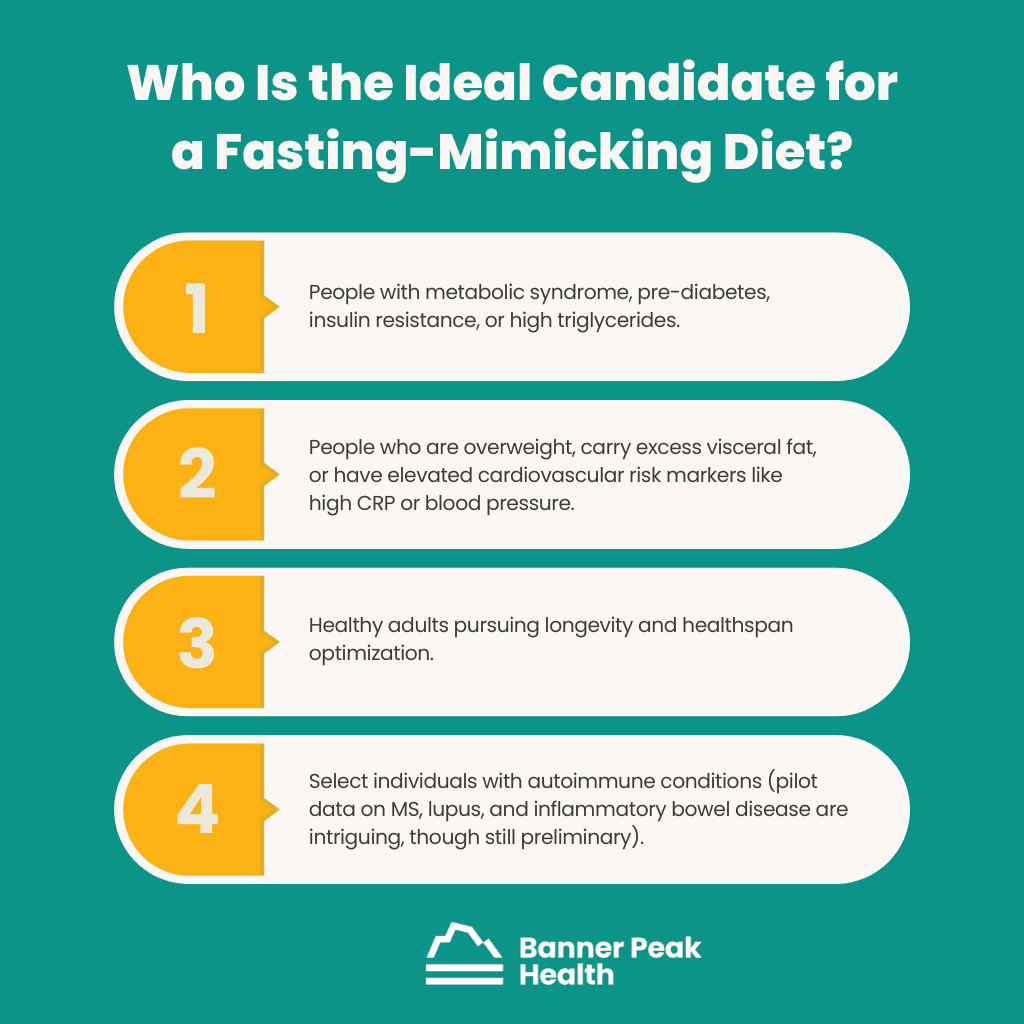
Who Is the Ideal Candidate for a Fasting-Mimicking Diet?
The fasting-mimicking diet is best suited for:
- People with metabolic syndrome, pre-diabetes, insulin resistance, or high triglycerides.
- People who are overweight, carry excess visceral fat, or have elevated cardiovascular risk markers like high CRP or blood pressure.
- Healthy adults pursuing longevity and healthspan optimization.
- Select individuals with autoimmune conditions (pilot data on MS, lupus, and inflammatory bowel disease are intriguing, though still preliminary).
The fasting-mimicking diet isn’t appropriate for:
- Pregnant or nursing women.
- Anyone with a history of eating disorders.
- Type 1 diabetics.
- Children or underweight individuals.
- Frail or elderly patients, type 2 diabetics on insulin or sulfonylureas, patients on warfarin, or those with severe kidney or liver disease.
- Cancer patients undergoing active treatment (emerging protocols may change this, but the evidence isn’t there yet).
Note: One population worth mentioning: patients considering GLP-1 medications like Ozempic for metabolic improvement. For people on the fence, the FMD offers a comparable tool with added lifestyle benefits, lower cost, and greater sustainability. It’s worth a conversation with your physician before committing to a medication when a dietary approach may accomplish similar goals.
Today’s Takeaways
The fasting-mimicking diet bridges the gap between the cellular benefits of a traditional fast and the practicality of a protocol most people can follow. It’s a five-day, physician- and dietitian-guided intervention that can improve metabolic markers, reduce inflammation, and serve as a catalyst for lasting lifestyle change.
But it isn’t a stand-alone fix. The FMD works best as part of a broader exercise and health strategy that includes:
- Sleep quality and architecture
- Zone 2 and resistance training
- Whole, unprocessed foods and mindful eating
- Stress management
If you’re interested in exploring whether the fasting-mimicking diet is right for you, don’t go at it alone. Get baseline labs and measurements first. Work with a physician and dietitian who can tailor the protocol to your body, track your progress, and adjust the plan based on real data.
The before-and-after numbers do more than measure outcomes; they build motivation for sustainable change.
At Banner Peak Health, we partner with registered dietitians like Angela Stanford to offer the FMD as part of our personalized preventive care. Contact us today to learn more.