On two occasions, I’ve had the good fortune to travel to Costa Rica. It’s a travel destination I’d recommend to anyone.
Costa Ricans have done an extraordinary job prioritizing rainforest preservation. They realized early that ecotourism built around intact rainforests would generate more long-term income than slashing and burning for a few years of agricultural output.
Traveling there, you come to understand the value of preserving the rainforest: you can’t recreate one. A rainforest develops slowly over time as hundreds, if not thousands, of living organisms evolve together into a balanced, interdependent system. Adding a few key components cannot build a new rainforest.
What Are Stem Cells (and Why Do People Want Them in Their Knees)?
When thinking about stem cell therapy for knees, you first have to understand what a stem cell is and why it seems, at first glance, like the perfect fix.
In medicine, the term “pluripotent” means a cell can develop in many different directions. Embryonic stem cells, the cells found in an embryo or placenta, represent the ultimate potential of that concept. A handful of cells in an early embryo can develop into every cell type in the human body. That’s the ultimate potential of pluripotency.
The science of stem cells has expanded over the decades. We learned pluripotent cells exist not only in embryos but also in bone marrow, which is hard to access, and eventually in fat tissue. That discovery raised an appealing prospect: conveniently harvesting a patient’s own stem cells from fat and reinjecting them into damaged joints.
If pluripotent stem cells can grow an entire baby, they can at least grow a little bit of knee cartilage, right? I’ve applied this same skepticism when evaluating peptides, and the instinct to question appealing-sounding therapies has served me well.
A Clue From the Rotator Cuff
Before we get to the knee data, one orthopedic indication does show a stronger signal: partial-thickness tears of the rotator cuff.
The rotator cuff occupies a fixed bony space between the clavicle and the acromion. An injury causes swelling, and that swelling in a confined space creates more pinching, which creates more swelling. It’s a feed-forward loop, the same kind of self-reinforcing pattern we’ve discussed with carpal tunnel.
Stem cell injections work better here for a specific reason: they transiently reduce inflammation, which interrupts the feed-forward cycle and allows healing to proceed. The mechanism is temporary inflammation reduction in a confined space, not regrowth of the shoulder.
That distinction matters when we evaluate stem cell therapy for knees. The knee doesn’t have the same confined-space anatomy. Calming inflammation temporarily doesn’t address the underlying structural problem.
Does Stem Cell Therapy for Knees Actually Work?
I was surprised to find a number of high-quality placebo-controlled trials studying stem cell therapy for knees. We have better data on this question than I expected.
The bottom line: the benefit is real but modest, both in magnitude of pain relief and duration of action. A 2024 meta-analysis of 16 randomized trials found stem cell injections provide little to no pain relief at three to six months compared to placebo. The improvement is minimal, and sustained benefit fades after six months compared to placebo alone.
When researchers look at what’s happening anatomically, stem cell therapy for knees doesn’t regrow cartilage. It doesn’t reverse arthritis, but it can transiently reduce inflammation. Nowhere in the orthopedic literature does an injection rebuild a joint.
Here’s where we come back to Costa Rica.
Why Stem Cells Can’t Regrow the Rainforest of Your Knee
A knee joint, like a rainforest, is a complex system built through decades of interrelated biological processes. Cartilage, bone, connective tissue, synovial fluid: these components developed together over a lifetime. The body’s balance between building and breaking down tissue is complex, and the idea that an injection of stem cells can restore this structure is appealing but unsupported by the anatomical evidence.
If we can get a whole baby, surely we can get just a little bit of knee. But that’s not how it works. A baby grows from stem cells through an interdependent cascade of signaling and differentiation, all of the components evolving together. Injecting cells into a damaged knee isn’t the same process.
You can’t rebuild the rainforest of your knee, and you can’t regrow a joint with an injection. The best you’ll get is a few months of modest pain relief before the benefit fades.
The Real Cost of Stem Cell Therapy for Knees
Let’s talk about risk and benefit.
On the safety side, the procedure is straightforward: you’re taking cells from your own body and putting them back in. Assuming a safe medical facility, the risk of the injection itself is low.
The financial cost is the bigger concern. Stem cell therapy for knees isn’t covered by insurance. A single injection can run $5,000 or more, and commercial centers often recommend multiple injections.
That adds up fast.
Then there’s opportunity cost. No law says you can’t add stem cell injections on top of proven therapies. But in practice, spending thousands of dollars on a procedure with modest, temporary results can displace the proven technology that works better: physical therapy.
If a patient had unlimited financial resources and was already maximizing an ambitious physical therapy program, the literature could support adding stem cell therapy. My concern is that for most people, the money spent on stem cell injections comes at the expense of the treatment with stronger evidence.
Commercial Claims About Stem Cell Therapy for Knees
A recurring theme in our blog posts is the intersection between new medical technology and capitalism. Stem cell knee treatment is a textbook case.
Commercial advertisements often include language like “regenerate your cartilage,” “heal naturally with your own cells,” or “avoid surgery.” The literature doesn’t support these claims. These marketing tactics echo the same misleading supplement industry messaging we’ve cautioned against before.
Some clinics tout impressive success rates. The research does support minimal improvement in pain, but there’s a placebo response at work, too. Once you’ve paid $5,000 and committed to the process, you want to feel better.
The commercial claims for stem cell therapy for knees far outpace what the clinical trials actually show. Be skeptical of any facility that promises regeneration. The evidence shows temporary pain reduction at best.

What to Do Instead of Stem Cell Therapy for Knees
The data points toward a clear hierarchy of treatments for degenerative knee conditions, and stem cell injections aren’t at the top.
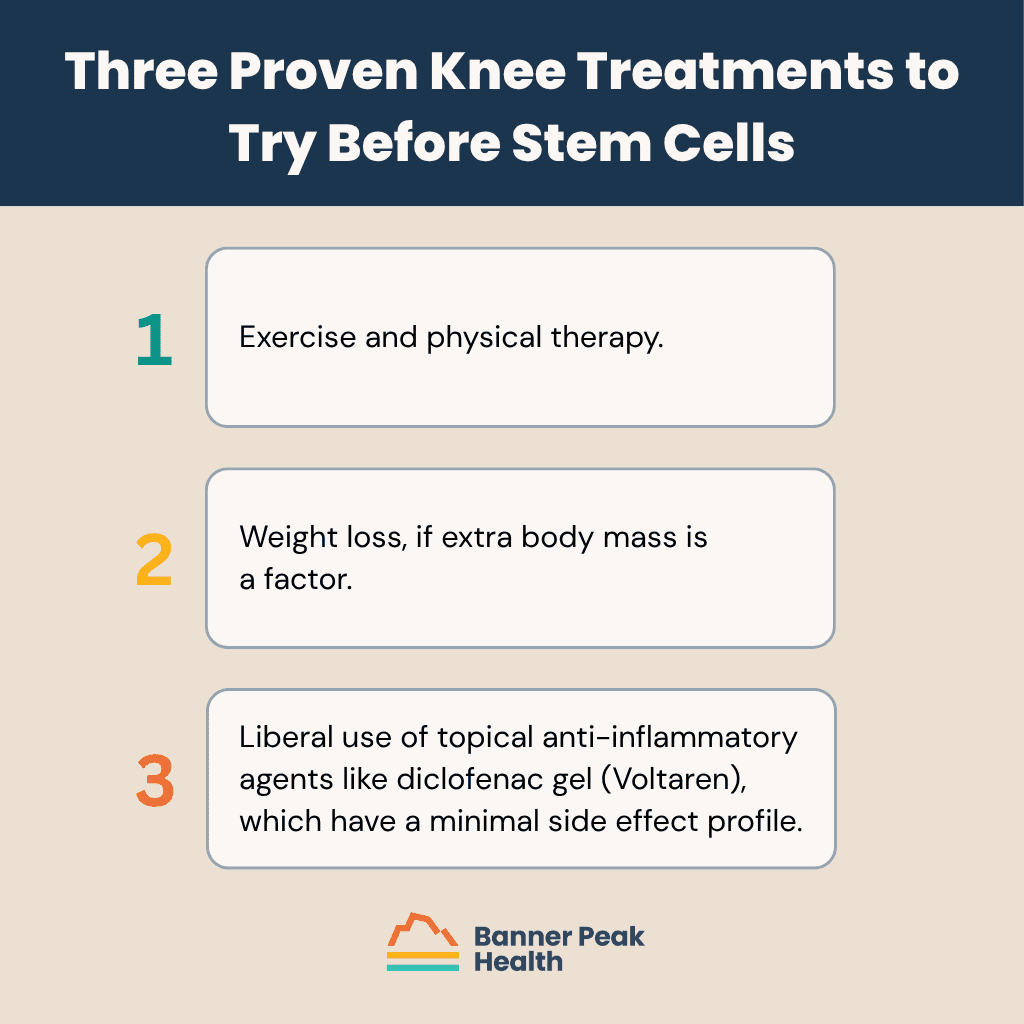
First: exercise and physical therapy. The evidence for improved functional outcomes, pain reduction, and delayed joint replacement is strongest here.
Physical therapy isn’t a single black box. The quality of the practitioner matters, and so does how well the patient follows through. But the data is the data, and it’s far more convincing than what exists for stem cell therapy.
Second: weight loss, if extra body mass is a factor. Extra body mass adds mechanical stress to the knee joint.
Third: liberal use of topical anti-inflammatory agents like diclofenac gel (Voltaren), which have a minimal side effect profile. Careful, judicious use of oral anti-inflammatory drugs like ibuprofen or naproxen can help on bad days, but these carry a higher potential for systemic risk with frequent use.
Today’s Takeaways on Stem Cell Therapy for Knees
Stem cell therapy for knees offers real but modest pain relief that fades within months. It doesn’t regrow cartilage, doesn’t reverse arthritis, and doesn’t change the long-term progression of joint disease. The commercial marketing around this therapy vastly oversells the evidence.
The proven treatments, physical therapy, weight management, and judicious anti-inflammatory use, remain the best tools for managing degenerative knee conditions. At Banner Peak Health, we help patients build a preventive plan that includes the right balance of evidence-based therapies.
As for the rainforest: protect the one you’ve got. It’s easier to preserve a knee than to rebuild one.