
If a patient asked me, “Is it too hot in Omaha, Nebraska?” I couldn’t answer without more information. Is it morning or noon, winter or summer? Context changes the answer.
The same principle applies to blood pressure. Like the weather, blood pressure is always on the move, rising and falling throughout the day. A single number, taken out of context, can be as misleading as a cholesterol reading without a calcium score.
If this concept, that context dictates the answer, is the only information you take away from this blog post, the read was worth your time.
Can Anxiety Cause High Blood Pressure?
Yes, anxiety can cause high blood pressure temporarily. When we feel stressed, our bodies translate the emotional experience into biology through hormones like adrenaline and cortisol. These hormones increase heart rate, constrict blood vessels, and increase blood flow throughout the body.
The result: blood pressure goes up. Chronic stress can even change the way our bodies store and distribute fat, compounding the cardiovascular burden over time. Whether that spike is harmful depends, once again, on context.
We evolved this hormonal surge, called the sympathetic response, to give us power when we need it. Our ancestors needed that rush of adrenaline to escape a saber-toothed tiger. The response is adaptive; it kept our species alive.
The distinction is duration. If the spike is temporary, it’s adaptive. If stress and high blood pressure become chronic, it’s no longer protective; it’s a disease called hypertension, and it damages blood vessels, the heart, and organs over time.
White Coat Hypertension: The Modern Saber-Toothed Tiger
We’ve all lived this scenario: You left for the doctor’s office late. Traffic was worse than expected. The parking lot was full. The office was on the second floor, and you couldn’t wait for the elevator. You ran up, sat down, and the medical assistant immediately strapped the blood pressure cuff on you.
Under these conditions, the modern equivalent of the saber-toothed tiger has your hormones firing. I’ve experienced this situation myself. I’ve seen my own blood pressure read 150/100 in the office when, on a restful day at home, I’m closer to 120/70. (I’ve written about my high blood pressure experience in more detail on our blog.)
This phenomenon is called “white coat hypertension.” A white coat is what physicians traditionally wore in medical settings. If you know what a phone booth is, you probably remember the white coat, too. And if you remember the little plastic adapter for 45 RPM records, it’s time for a colonoscopy.
White coat hypertension affects 15–30% of people who get blood pressure readings in a doctor’s office. Even without rushing to get there, the environment itself can trigger enough cortisol and adrenaline to produce an artificially elevated reading.
How to Get an Accurate Blood Pressure Reading
If anxiety and blood pressure readings are so closely tied to context, the next logical question is: what are the correct conditions for an accurate reading?
The American Heart Association guidelines are specific.
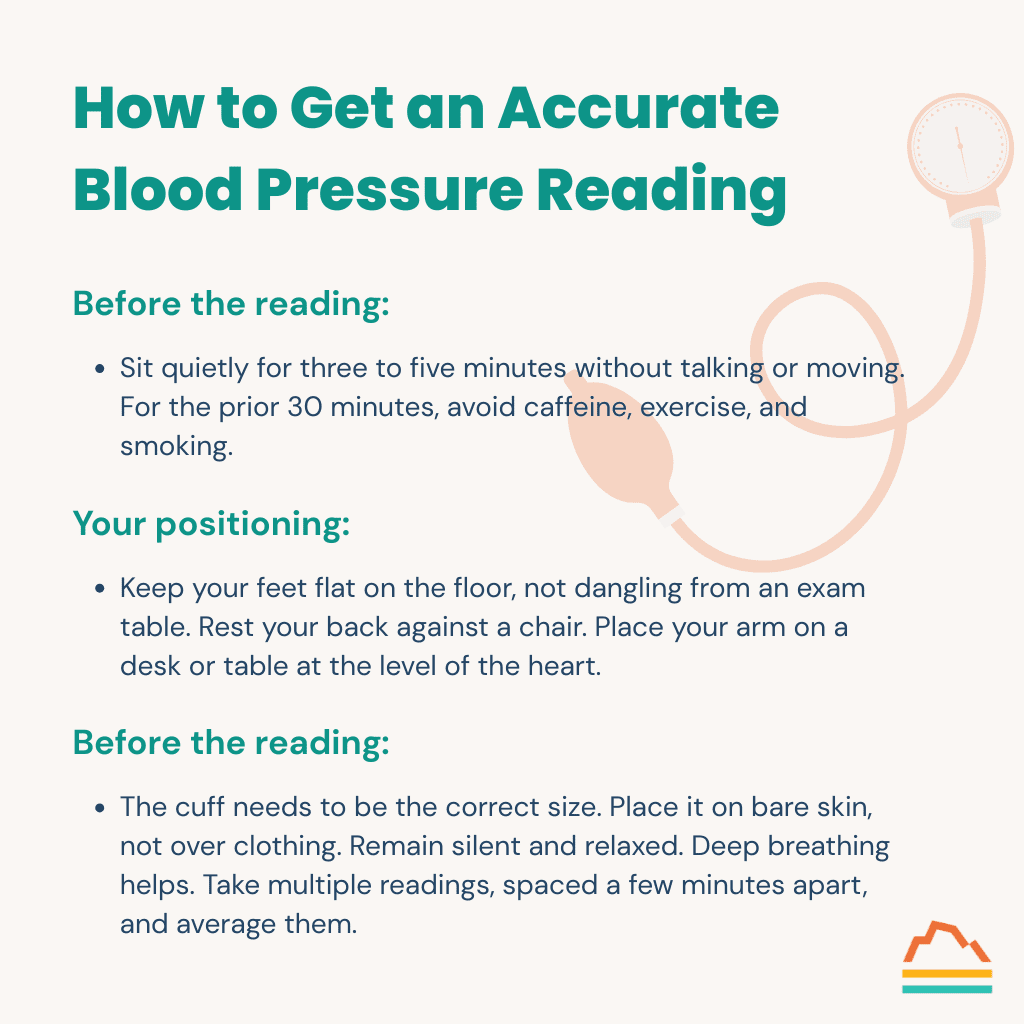
Before the reading: Sit quietly for three to five minutes without talking or moving. For the prior 30 minutes, avoid caffeine (and know how long caffeine stays active in your system), exercise, and smoking. Empty your bladder.
Your positioning: Keep your feet flat on the floor, not dangling from an exam table. Rest your back against a chair. Place your arm on a desk or table at the level of the heart. That last point deserves special attention, and you can test it on yourself right now.
At the top of your sternum (the bone in the center of your chest), you’ll feel a small V-shaped notch called the sternal notch. At the very bottom of that bone, before it gives way to your abdomen, you’ll find a small point called the xiphoid process.
Halfway between those two landmarks is where your heart sits. The blood pressure cuff on your arm needs to be at that height.
If the cuff sits below the level of your heart, the reading will be falsely elevated. I can’t overstate how often I see this done incorrectly.
One more detail: Your arm must be passively supported at that height. Using muscle tension to hold your arm up changes how the artery runs through the bicep and skews the reading.
During the reading: The cuff needs to be the correct size. Place it on bare skin, not over clothing. Remain silent and relaxed. Deep breathing helps. Take multiple readings, spaced a few minutes apart, and average them.
Following all these rules is nearly impossible during a typical doctor’s office visit. Getting an accurate picture of your blood pressure requires monitoring at home.
Modern home blood pressure cuffs are fairly accurate. Try different times of day, follow the rules above, and bring the results to your next appointment.
Can Repeated Anxiety Spikes Lead to Chronic Hypertension?
Yes. The medical literature shows an association between frequent anxiety-driven spikes and the development of chronic hypertension.
The more nuanced question is causality. Are the spikes themselves causing chronic high blood pressure? Or does anxiety, more broadly, skew your hormonal balance over time, and that hormonal imbalance is what drives hypertension?
It’s a distinction without a difference. Anxiety management tools are blood pressure management tools. Addressing anxiety, whether through breathing techniques like belly breathing, exercise, sleep, or other stress-reduction practices, directly supports cardiovascular health.
True Hypertension vs. a High Blood Pressure Reading
A single elevated reading in the doctor’s office doesn’t mean you have hypertension. True hypertension is what you discover when you follow all the rules at home, take readings at different times of day, average the results, and still see elevated numbers consistently.
The medical community categorizes blood pressure into stages: normal, elevated, stage 1 hypertension, and stage 2 hypertension. Each stage has specific numerical cutoffs that guide treatment decisions. For a detailed breakdown of those stages, refer to our post on how long blood pressure medicine takes to reach its full effect.
If your home readings confirm pre-hypertension or hypertension, that’s the starting point for a conversation with your physician about management.
Managing Anxiety and High Blood Pressure
For mild elevations without additional risk factors, your physician will likely start with lifestyle modifications:
- More sleep
- Regular exercise (even walking 10,000 steps a day can make a measurable difference)
- Weight management
- Reduced alcohol intake
- Stress reduction (wearable devices that track heart rate variability can help you monitor stress levels and measure your progress)
If lifestyle changes don’t bring your numbers into range, or if your blood pressure is higher and you have additional risk factors, you’ll enter a discussion with your physician about medication. The prescription for managing high blood pressure is always lifestyle plus or minus medication.
You won’t be told to skip the lifestyle changes and rely on pills alone. Pharmacologic treatment builds on maximizing every non-drug intervention first.
Today’s Takeaways
Anxiety can cause high blood pressure temporarily, and over time, chronic anxiety may contribute to true hypertension.
Invest in a high-quality home blood pressure cuff and learn the rules for accurate measurement. Next time you get your blood pressure checked in a healthcare setting, advocate for proper technique. The staff taking your reading may not have the time or awareness to follow every guideline, but now you do.
At Banner Peak Health, we spend time helping our patients distinguish between a stress-driven spike and a true pattern of hypertension. That distinction, and the personalized management plan that follows, is the kind of care we believe every patient deserves.