

Peptide therapy is the talk of the town right now. It shows up in wellness influencer feeds, online sellers, and clinic offerings. Most of what’s being sold isn’t proven, isn’t regulated, and doesn’t belong in anyone’s body.
The story everyone wants to tell is about the therapeutic potential of these compounds. The harder story, and the one worth telling, is about how patients, physicians, and society decide what goes into our bodies.
Here’s the short answer on gray-market peptides like BPC-157, TB-500, and CJC-1295: I don’t recommend them. The longer answer says more about how we think about evidence and hype than about any one compound. Patients curious about where the line falls between approved GLP-1 medications and gray-market versions will find that distinction is at the heart of the matter.
What Are Peptides?
A peptide is a chain of amino acids, the same building blocks that make up proteins in the body. Think of beads on a string, 20 to 50 long, folding into a three-dimensional shape that gives the molecule its function.
These small structures act as chemical messengers, regulating hunger, blood sugar, growth, and immune function. The body produces thousands of them. Insulin is the most familiar peptide hormone in the body, the one that controls blood sugar.
Beyond what the body produces, more than 80 peptide drugs hold FDA approval, with hundreds more in development. These are well-studied medications used in mainstream medicine, with documented safety and efficacy.
FDA-Approved Peptides vs. Gray-Market Peptides
Approved peptide drugs come with substantial clinical data. The GLP-1 agonists semaglutide (Ozempic, Wegovy) and tirzepatide (Mounjaro) have both been studied in tens of thousands of patients across the STEP and SURMOUNT Phase 3 programs, alongside tesamorelin (Egrifta) and other approved peptide drugs. Their production is regulated for safety and purity.
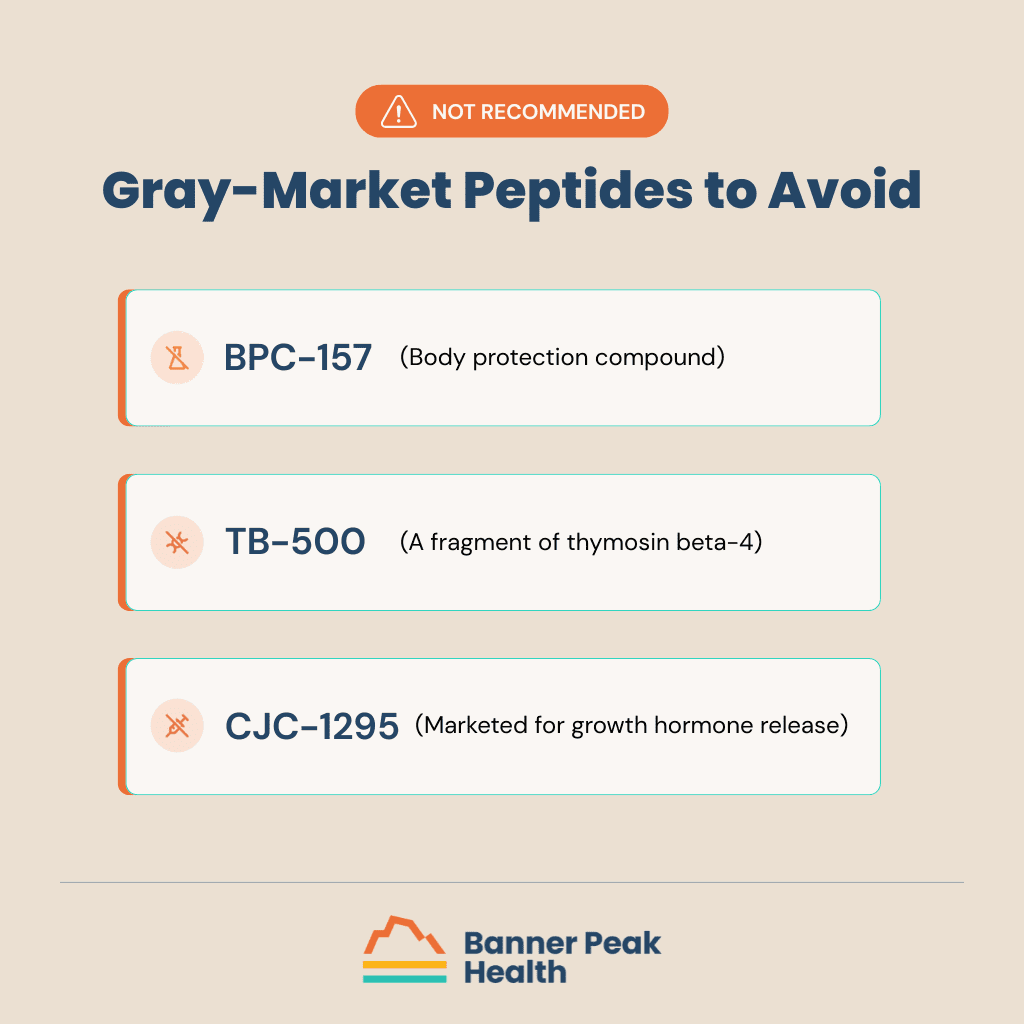
Gray-market peptides sit on the other side of the line. Compounds like BPC-157 (body protection compound), TB-500 (a fragment of thymosin beta-4), and CJC-1295 (marketed for growth hormone release) are sold online without FDA approval. These peptides carry a “for research use only” label, which sidesteps FDA oversight as they reach consumers.
The label is the epitome of irony. A compound marked for “research” and then injected into people without any valid human studies has the worst of both worlds: no oversight and no proof.
For a clear contrast to the gray-market approach, read our guide on how to make safe choices with supplements.
The Risks of Gray-Market Peptides
The risks break into two categories. The first is the biological risk of the compounds themselves. The second is contamination and poor manufacturing.
On the compound side, growth hormone-releasing peptides like CJC-1295 carry a theoretical risk of insulin resistance, joint pain, fluid retention, and abnormal tissue growth, the medical euphemism for cancer. TB-500 and related peptides that promote blood vessel growth carry a parallel theoretical risk of stimulating tumor growth, with no human studies to quantify its magnitude.
The manufacturing risk is documented rather than theoretical. Testing of gray-market peptide products has reported purity levels ranging from 5% to 75%. The unknown remainder includes arsenic, lead, and other heavy metals, as identified in independent testing.
Bacterial contamination raises the stakes further. Injection beneath the skin bypasses the body’s first lines of immune defense, so the risk of infection runs well above that of oral medications. The combination of unknown purity and infection risk makes any individual gray-market peptide injection unpredictably dangerous.
The Decision Behind Peptide Therapy
Decisions about what to put in our bodies happen at three levels: the individual, the physician, and society.
Individual decisions sit at the center. Personal beliefs shape them, including religious and philosophical views on foreign substances, comfort with new technology, and personal risk tolerance. External forces shape them, too, including family, friends, social media, influencers, podcasts, and institutional medicine.
Physicians sit further from the action than we tend to think. The medical community overestimates its own influence on individual decisions and underestimates the role of social and cultural forces. The peptide trend exists at this intersection, where individual choice, social signals, and the limits of physician influence collide.
What COVID Taught Us About the Peptide Trend
The COVID vaccine experience taught the medical community a hard lesson about evidence and influence. Billions of doses had been administered worldwide following thousands of studies, with overwhelming evidence that the benefits exceeded the risks, yet vaccine hesitancy remained substantial enough to fuel a political movement.
The medical community learned that most people don’t think the way physicians do, and that scientific evidence has limits as a driver of individual choice. Group thinking, personal experience, and social signals carry as much weight as data, and often more.
Peptides show the same pattern in reverse: evidence is thin, yet the wave of interest and use keeps building. A dangerous combination drives the trend: plausible biology, compelling anecdotes, and insufficient data.
Today’s Takeaways
Gray-market peptides are not on my recommendation list. The evidence base is thin, the manufacturing is unreliable, and the risks are documented enough to take seriously.
The deeper lesson from the peptide trend is about how to think through medical decisions when the marketplace is loud and the data is quiet. Slow down and ask what’s been studied, by whom, at what scale, with what oversight.
For gray-market peptides, that answer is not enough.
At Banner Peak Health in Walnut Creek, we work with patients on exactly this kind of question. To talk through a specific peptide or treatment that’s caught your interest, reach out to our practice.
Frequently Asked Questions About Peptides
Are peptides safe?
FDA-approved peptide drugs like semaglutide and tirzepatide have substantial safety data from tens of thousands of patients. Gray-market peptides like BPC-157, TB-500, and CJC-1295 lack human trials and carry documented risks from both the compounds themselves and from manufacturing contamination.
Is BPC-157 legal in the United States?
BPC-157 is not FDA-approved for human use. The compound is sold online with a “for research use only” label, which sidesteps FDA oversight and allows it to reach consumers without the safety and efficacy review that approved drugs go through.
What’s the difference between FDA-approved peptides and gray-market peptides?
FDA-approved peptides have been studied in tens of thousands of patients with documented safety and efficacy, and their production is regulated for purity. Gray-market peptides are sold online without regulatory oversight, and independent purity testing of gray-market products has reported values as low as 5% and ranging up to 75%, with the remainder consisting of arsenic, lead, and other heavy metals.
Why are gray-market peptides risky to inject?
Injection bypasses the body’s first lines of immune defense, raising the risk of infection well above that of oral medications. Combined with unknown compound purity and documented heavy-metal contamination, any individual gray-market peptide injection becomes unpredictably dangerous.