
Is sunshine good or bad?
The honest answer depends on context, degree, and perspective. Sunshine grows crops, powers solar energy, and lifts our mood. It can also cause skin cancer, contribute to drought, and accelerate climate change.
Most medical decisions operate in this same gray area, yet we crave binary verdicts: good or bad, safe or dangerous, worth it or not. Whole body MRI doesn’t fit neatly into either column.
Direct-to-consumer marketing has fueled a boom in these scans, with standalone centers offering these screenings for $1,000 to $2,000, no physician referral required. The pitch positions the scan as a sort of do-it-yourself executive physical: detect problems early and buy yourself peace of mind.
Peace of mind is a powerful promise. For most people, the math tells a different story, one in which a whole body MRI creates more anxiety than it resolves.
What a Whole Body MRI Can and Can’t Detect
The scan performs well at detecting solid organ tumors in the kidney, liver, and prostate. It can identify intracranial aneurysms (dangerous dilations in the brain with rupture potential) and soft tissue masses, all without ionizing radiation, a meaningful advantage over CT-based screening.
The modality does find cancer. A 2026 meta-analysis in European Radiology, reviewing data from 9,000 asymptomatic individuals, found a cancer detection rate of 1.57%.
For specific high-risk genetic conditions, the evidence supports routine screening. NCCN guidelines recommend annual screening MRI for individuals with Li-Fraumeni syndrome, a genetic predisposition carrying an elevated risk of solid tumors. In this select population, the scan earns its place in a proactive cancer prevention plan.
Whole body MRI can detect solid organ tumors and brain aneurysms without radiation, but it can’t replace targeted screenings for the most common cancers. Colon cancer, breast cancer, and thyroid cancer each require dedicated screening modalities: colonoscopy, mammography, and ultrasound. A clean scan result can create a false sense of security and leave these cancers undetected.
Screening vs. Diagnostic: Why the Distinction Matters
A diagnostic MRI starts with a hypothesis. Your physician suspects a lesion, a symptom points to a specific organ, and the scan focuses on answering a targeted clinical question.
A screening MRI is the opposite: a fishing expedition. No specific symptom or finding prompted the scan. The modality sweeps across the entire body looking for any abnormality.
Knowing the difference between a screening MRI and a diagnostic MRI changes how you interpret the results. The purpose and recommended frequency of medical testing change dramatically depending on whether you’re screening a healthy population or diagnosing a symptomatic patient. Screening a low-risk population with a broad-sweep imaging tool produces a flood of false positives.
The Math Behind a Whole Body MRI
Approximately one-third of asymptomatic adults who undergo this screening have incidental findings: liver cysts, renal cysts, disc bulges, uterine fibroids. These findings look alarming on a report, but they aren’t cancer. The false positive rate is the central problem with whole body MRI screening.
Consider a hypothetical scenario: 1,000 healthy 45-year-olds with no elevated cancer risk undergo screening. With a cancer prevalence of 0.2% (two people in 1,000 with actual cancer), a sensitivity of 90%, and a specificity of 68%, the numbers break down like this:
- Two people receive true positive results. They have cancer, and the scan found it.
- 319 people receive false positive results. The scan flagged an abnormality that isn’t cancer.
The positive predictive value (the probability that a positive result is truly positive) is 0.6%. If you put those 321 people with positive results in a room and tell them they might have cancer, only two of them actually do.
This math isn’t unique to this modality. It’s a principle of probability that applies to every screening and diagnostic test.
Any test’s usefulness depends on how likely you were to have the disease before the test. When you screen a low-risk population, even a sensitive test generates more false alarms than real diagnoses.
The False Positive Cascade
Those 319 false positives don’t end with an email and a shrug. Each one triggers a cascade of follow-up steps, each carrying its own costs in time, money, and emotional toll.
First comes the notification: a phone call informing you of a finding that “might be cancer, might not be.” Anxiety begins immediately. Next, follow-up imaging: a contrast-enhanced MRI or CT scan that costs thousands of dollars and takes weeks to schedule, all with uncertainty hanging overhead.
Depending on the finding’s location and appearance, a specialist consult may follow. Then, potentially, a biopsy, an invasive procedure with its own physical risks. If the biopsy proves inconclusive, the next step is serial surveillance: reimaging at three, six, or 12 months.
For the overwhelming majority of those 319 people flagged by the screening scan, weeks or months of heightened stress and physiological strain, thousands in additional testing, and the physical risk of invasive procedures end with the same answer: no cancer. The promise of peace of mind delivered its opposite.
The Direct-to-Consumer Problem
A standalone scanning company collects $1,000 to $2,000, performs the scan, hands over a report, and walks away from the relationship. Your existing healthcare team is then responsible for the entire workup cascade described above. This is the “take the money and run” model of healthcare.
Direct-to-consumer whole body MRI centers profit from scanning as many people as possible, regardless of individual appropriateness. A for-profit center won’t decline a paying customer whose risk profile doesn’t justify the test.
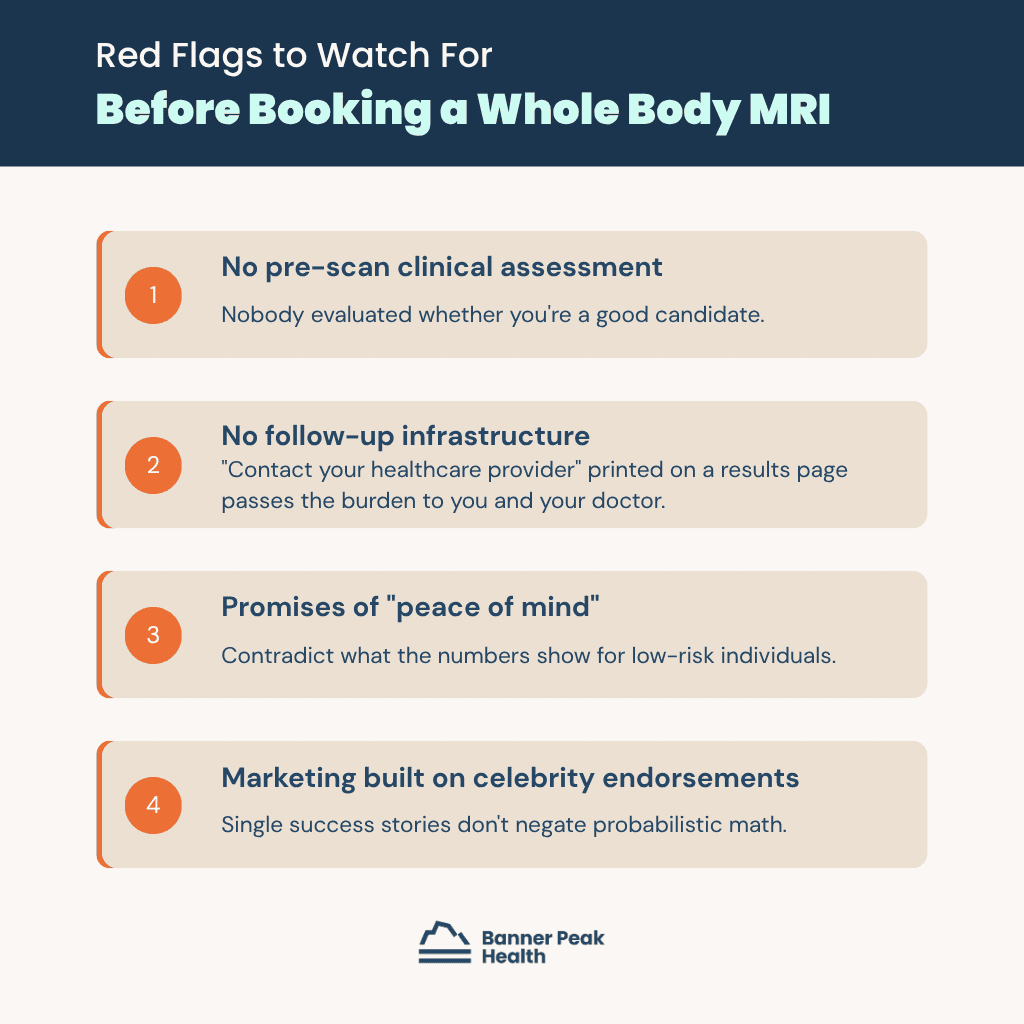
Watch for these red flags before booking a scan. No pre-scan clinical assessment means nobody evaluated whether you’re a good candidate. No follow-up infrastructure means “contact your healthcare provider” printed on a results page passes the burden to you and your doctor.
Promises of “peace of mind” contradict what the numbers show for low-risk individuals. Marketing built on celebrity endorsements or single success stories doesn’t negate probabilistic math.
A concierge medical practice takes a different approach: a physician who knows your history orders the test, frames your pre-test probability, and owns whatever the scan finds.
Today’s Takeaways on Whole Body MRI Scans
The whole body MRI question depends on your clinical context and your pre-test probability of cancer. It depends on your personality and tolerance for the anxiety that comes with a modality heavy with false positives. It depends on whether your healthcare environment can adequately work up an incidental finding.
For individuals with genetic syndromes carrying elevated cancer risk, the math is different. When the pre-test probability rises from 0.2% to 10%, the positive predictive value can climb to 50%: one false positive for every true positive. For these patients, the scan earns its place.
The same logic applies to aneurysm screening. The false positive rate remains high, and no evidence demonstrates improved mortality in average-risk populations.
For the average healthy adult without elevated risk, the odds stack against benefit. A whole body MRI is extra sauce in a layered early detection strategy, not the main course. Don’t let a slick advertisement replace a conversation with your doctor.
Have questions about advanced diagnostic screening? Contact Banner Peak Health to discuss whether this or any screening makes sense for your individual risk profile.