

Patients ask me all the time whether they’re better off eating vegetables raw or cooked. It doesn’t matter as much as you’d expect.
The single highest-leverage habit you can build is eating more vegetables and eating a greater variety of them. As I discussed in my recent post on prebiotic supplements and fiber, most of my patients aren’t getting anywhere near enough plant diversity in their diets. I’d rather see you eat a cooked vegetable than skip it entirely.
Cook them, eat them raw, sauté them: whatever compels you to eat more of them is the right approach.
That said, does cooking destroy nutrients? Yes, to a degree. The science behind how heat denatures beneficial compounds in food is worth knowing, especially if you want to squeeze more nutritional value out of every meal.
What Happens When Heat Denatures Beneficial Compounds in Food
When you heat food, you’re adding kinetic energy. That energy breaks the bonds holding together complex biological structures within the food’s compounds. The biological activity of these compounds often depends on their intact structure; once heat disrupts that scaffolding, the compound can become less active or entirely inactive.
Water-soluble vitamins face a double threat. Heat degrades them directly, and cooking in water causes them to leach from the food into the liquid. Unless you’re making a soup or stew where you’ll consume that cooking liquid, those nutrients disappear down the drain.
Consider carrots. If you steam them in the microwave submerged in water and then discard the liquid, you’re losing a large portion of their water-soluble vitamins. The same applies to any vegetable cooked in water you don’t consume.
Which Nutrients Does Cooking Destroy First?
Not all nutrients break down at the same rate. A clear hierarchy of heat sensitivity exists, and knowing it helps explain why certain cooking methods matter more than others.
Vitamin C tops the list as the most heat-sensitive vitamin. Cooking can destroy anywhere from 50% to 80% of a vegetable’s vitamin C content. That makes raw preparations particularly valuable for vitamin C-rich foods like bell peppers and broccoli.
Polyphenols and B vitamins (B1 in particular) rank next. These compounds break down readily under heat exposure, and B vitamins’ water-soluble nature means they leach out during boiling or simmering.
Fat-soluble vitamins (A, D, E, and K) degrade through a slightly different process. Heat generates free radicals that attack conjugated double bonds in these vitamins, breaking them into inactive fragments. The mechanism differs, but the result is the same: less active nutrient content.
Omega-3 fatty acids are fairly heat-sensitive as well. If you’re interested in how omega-3s function in the body and why they matter for cardiovascular health, Dr. Rotman has written about the topic in his post on fish oil supplementation.
Proteins and fats round out the hierarchy. They’re the most heat-stable macronutrients, but prolonged cooking at high temperatures still degrades them.
Prep Tricks That Preserve Nutrition
Cooking can destroy nutrients, but how you prepare vegetables before they hit the heat makes a measurable difference in their nutritional profile.
Chop Your Garlic Early
When you chop garlic, the mechanical breakdown of cell walls activates an enzyme called alliinase. That enzyme converts alliin to allicin, the compound responsible for garlic’s cardiovascular, antimicrobial, and cancer risk reduction benefits. Swallowing a whole cooked clove delivers a very different nutritional profile than eating a chopped clove that sat for five to 10 minutes before cooking.
Chop your garlic first when prepping a meal. Let it rest for five to 10 minutes before it hits the pan. If you’re making a pasta sauce, resist the urge to toss in whole cloves; chop them and mix them throughout.
Chop Cruciferous Vegetables and Let Them Sit
Broccoli and other cruciferous vegetables follow a similar principle with a different enzyme. Chopping activates myrosinase, which converts glucoraphanin into sulforaphane, a compound with strong anti-cancer properties. The catch: myrosinase itself isn’t heat-stable, but the sulforaphane it produces is.
Myrosinase needs enough time to do its work before you cook. Some data suggests chopping broccoli 90 minutes before stir-frying can increase sulforaphane content by 2.8-fold. That’s not exactly practical when you’re cooking dinner for a family, but even 30 minutes helps.
Make cruciferous vegetables the first item you chop during meal prep, then move on to the rest of your ingredients.
As I discussed in my recent post on growing broccoli sprouts at home, adding raw sprouts to meals is another fast way to boost sulforaphane intake without worrying about heat degradation at all.
One more trick: add mustard powder to cooked cruciferous vegetables. Mustard powder contains myrosinase, so sprinkling it on after cooking restarts the conversion process. It’s a simple way to get more sulforaphane from broccoli, cauliflower, and Brussels sprouts you’ve already cooked.
Chopping as a General Rule
Generally speaking, chopping your vegetables improves their nutritional content. The mechanical breakdown of cell walls releases and activates beneficial compounds across a wide range of produce, not only garlic and broccoli.
When Cooking Boosts Nutritional Value
Heat denatures beneficial compounds in most foods, but for certain compounds, cooking actually increases their bioavailability.
Carotenoids, found in carrots, tomatoes, sweet potatoes, and certain leafy greens, are locked behind tough plant cell walls. Heat breaks down those walls, loosening carotenoid-protein complexes and freeing them for better absorption.
Tomatoes offer the most striking example. Cooked tomatoes deliver two to five times more lycopene than raw tomatoes. Lycopene is a carotenoid with well-documented health benefits.
Eat tomatoes in your salad, absolutely, but add cooked tomatoes to your other meals as well. Whether you choose organic or non-organic varieties, you’ll absorb more lycopene from a cooked tomato than from a raw one.
Carrots and sweet potatoes follow the same pattern. Cooking these root vegetables makes their beta-carotene more accessible to your digestive system.
Best Cooking Methods to Preserve Nutrients
Not all cooking methods destroy nutrients equally, and the top-ranked method for preserving them surprises most patients.
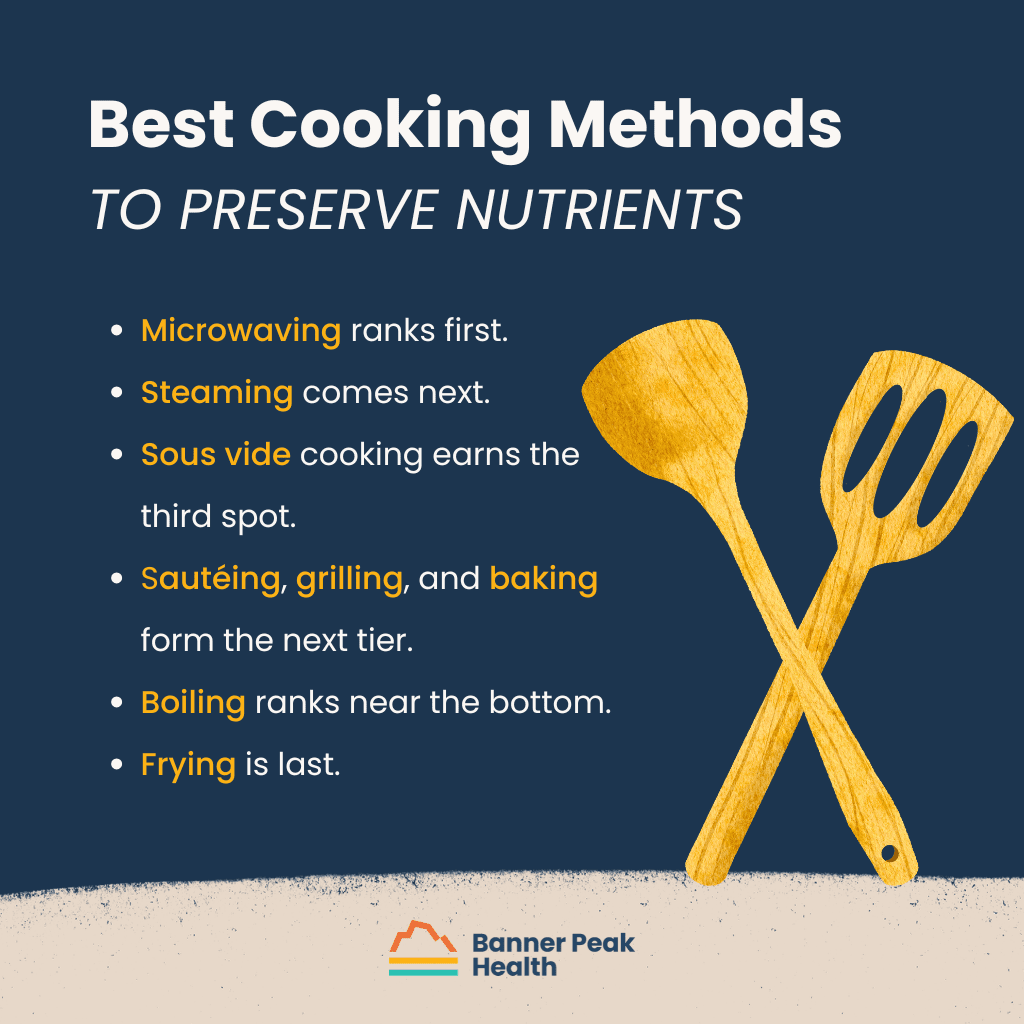
Microwaving ranks first. Most people don’t think of the microwave as a health tool, but short cook times and minimal water use make it one of the best ways to preserve nutritional content. Certain vegetables retain up to 90% of their vitamin C when microwaved.
Steaming comes next. It applies indirect heat without submerging vegetables in water, which prevents the leaching problem. If you’re taking a supplement for a specific nutrient, pairing it with properly steamed whole foods helps you cover more nutritional ground.
Sous vide cooking earns the third spot. The lower temperatures and vacuum-sealed environment protect heat-sensitive compounds, even over longer cook times.
Sautéing, grilling, and baking form the next tier. They’re all fine options, but they expose food to higher temperatures and longer cook times than the top three methods.
Boiling ranks near the bottom. High temperatures combined with full water submersion means you lose nutrients to both heat degradation and leaching. The exception: soups and stews where you consume the cooking liquid.
Frying is last. Beyond the nutritional profile concerns, it’s an inferior preparation method for other health reasons. Avoid it when you can.
How to Cook Without Destroying Nutrients
If turning every meal into a science experiment isn’t realistic (and for most of us, it isn’t), a few simple habits keep cooking from destroying nutrients.
Cook to minimal doneness. This is the easiest, most practical change. Heat exposure and time drive nutrient loss.
Keep your sautéed vegetables a bit crunchier. Pull your roasted broccoli a few minutes earlier; the less you cook, the more you retain.
Steam with small amounts of water. You don’t need a traditional steaming basket; a microwave works. Avoid submerging vegetables in water, which leaches water-soluble vitamins.
Eat raw when you can. A side salad, raw snacking vegetables, or chopped produce on top of a cooked dish all contribute to your intake without any heat-related nutrient loss.
Consume your cooking liquids. Pan sauces, soups, and stews capture the water-soluble vitamins that leach out during cooking. If you’re making a stir-fry, use the pan liquid.
Use convection for baking. Convection ovens circulate hot air, which cooks food faster. Less time at high heat means less nutrient degradation. Root vegetables and cruciferous vegetables do particularly well in the oven.
Coat vegetables with a thin layer of olive oil. The oil adds vitamin E and polyphenols back into the meal, partially offsetting some of what heat removes.
Today’s Takeaways
The question “Does cooking destroy nutrients?” has a nuanced answer. Yes, heat denatures beneficial compounds in food, and some nutrients are more vulnerable than others. But the nuance matters far less than the big picture.
Eat more vegetables. Eat a variety of them. Eat them raw and cooked, in every meal if possible.
That single habit will do more for your health than any cooking technique could undo.
Once you’ve built that foundation, the small adjustments, like chopping ahead of time, steaming instead of boiling, and cooking to minimal doneness, add up. They’re the fine-tuning on top of a strong metabolic foundation.
At Banner Peak Health, we work with patients to build sustainable nutrition habits that fit their real lives. If you’d like to discuss how your diet, cooking methods, and nutritional intake fit together, reach out to our team or bring it up at your next visit.