
When I don’t like my wife’s outfit and she asks for my opinion, I tell her.
People are often surprised I’d say that, but honesty gives my approval meaning. We’ve been together over 30 years, so it must be working.
The same principle applies in medicine. How often do you hear a physician say, “I don’t know”? Given how fast medical knowledge expands, what any doctor doesn’t know vastly exceeds what they do. Failing to admit that undermines faith in all their other claims.
At Banner Peak Health, we embrace the “I don’t know.” That intellectual humility creates the passion to find answers. The tool we reach for is Open Evidence, a medical AI platform built exclusively on published clinical literature, launched in 2023.
Unlike general AI, it doesn’t hallucinate. We use it daily, often hourly. I’ve previously written about how melatonin affects your sleep cycle, but when a patient recently asked about the link between melatonin and heart failure, my honest answer was, “I have no idea.”
So I opened Open Evidence, and what I found in a few minutes blew me away.
What Open Evidence Taught Me About Melatonin and Heart Failure
Melatonin usage is not a risk factor for heart failure. A large study tracked a patient population for 23 years and found no association between regular melatonin use and cardiovascular disease of any kind, including congestive heart failure.
What surprised me was the next finding. A growing body of evidence links taking melatonin to potential benefit for people already living with congestive heart failure.
A randomized, double-blind, placebo-controlled trial enrolled 92 patients with heart failure from reduced ejection fraction. Patients received 10 milligrams of melatonin daily for 24 weeks and showed measurable improvement across several physiological parameters.
A meta-analysis of three studies on melatonin as a treatment confirmed improvements in quality of life, reduced fatigue, better sleep, and improved cardiac markers, including pump function. Melatonin, the supplement millions take to fall asleep, shows measurable improvements in heart performance. That’s not what I expected to find.
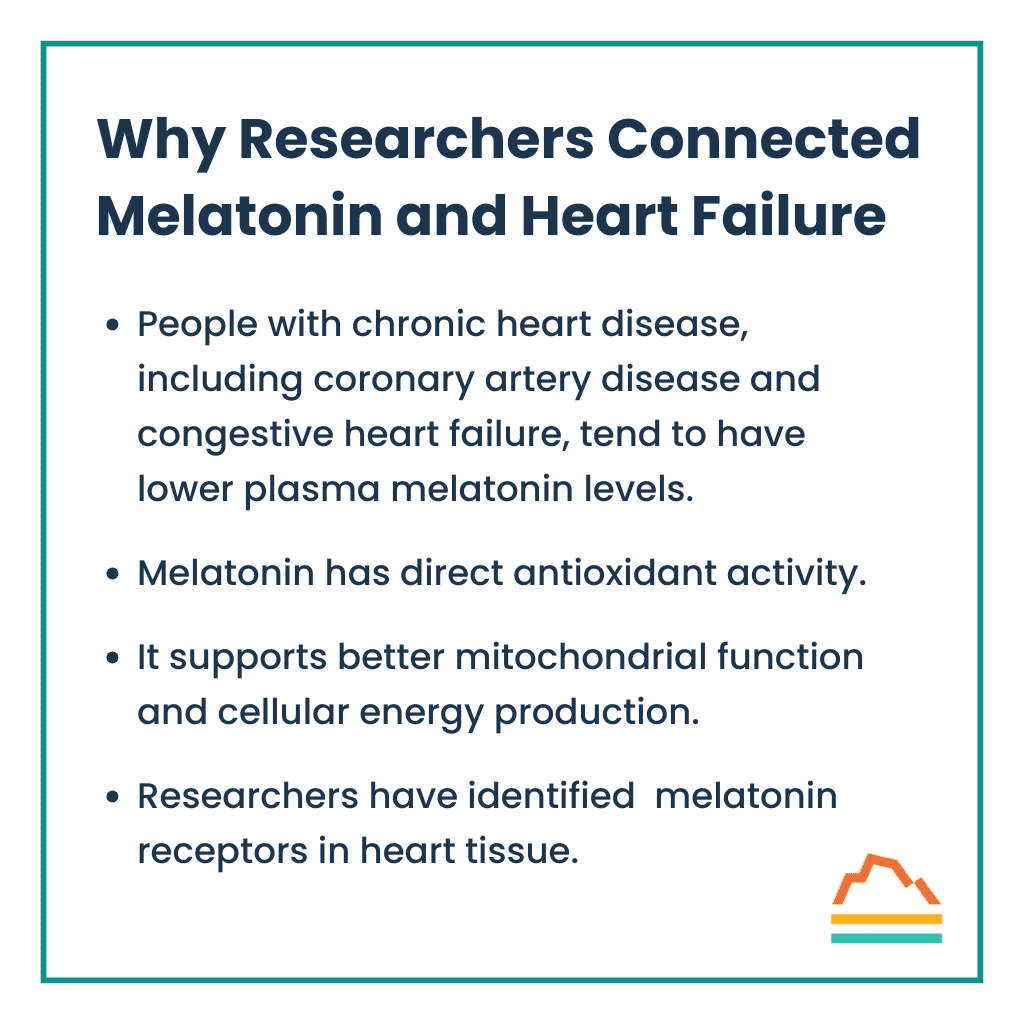
Why Researchers Connected Melatonin and Heart Failure
The next question Open Evidence helped me answer: Where did this idea even come from?
Three lines of evidence converge. People with chronic heart disease, including coronary artery disease and congestive heart failure, tend to have lower plasma melatonin levels. That association raised a hypothesis: If you raise melatonin exogenously, maybe you can improve cardiac function.
Animal models added two more pathways. Melatonin has direct antioxidant activity, reducing reactive oxygen species that drive degenerative disease, and it supports better mitochondrial function and cellular energy production. Researchers have identified melatonin receptors in heart tissue, suggesting a physiological link between melatonin and cardiac function.
That’s why controlled trials started.
Why This Isn’t Ready for Clinical Practice
The evidence is intriguing, but it isn’t sufficient.
The longest trial here ran 24 weeks. Congestive heart failure is a lifelong condition, and proof of concept over 24 weeks isn’t enough to change how we practice. The dose used in these studies, 10 milligrams, is at least 10 times what’s needed for sleep, making it supraphysiologic by any measure.
Over-the-counter melatonin preparations rarely disclose content or purity reliably. How you choose supplements matters, especially at doses this high. High-dose melatonin may worsen insulin resistance, which likely explains why the cardiac improvements in these studies appeared only in non-diabetic patients.
Today’s Takeaways
The melatonin and heart failure story is a good example of what intellectual humility looks like in practice. I didn’t know the connection existed. I used the right tool to find out, and I came away with a nuanced answer: Melatonin doesn’t cause heart failure, the early signals for benefit are real, and the evidence isn’t yet strong enough to act on clinically.
That “not yet” is as meaningful as the finding itself. At Banner Peak Health, that commitment to evidence-based preventive care shapes every conversation we have with patients. The first step in learning is being willing to say you don’t know.