

Think back to your school days.
At the end of each semester, you received a grade: a single number that reflected months of effort. That grade wasn’t your score on yesterday’s quiz. It integrated your homework, tests, attendance, midterm, and final exam into one indicator of how you performed over time.
Hemoglobin A1C works the same way for your metabolic health. But what is hemoglobin A1C?
This single blood test captures your average blood sugar control over the past 90 days. Unlike a semester grade that only affects your transcript, hemoglobin A1C is far more consequential. It reflects your risk for diabetes, heart disease, cancer, dementia, autoimmune conditions, and even depression.
Metabolic health influences almost every disease we face. That’s why knowing what hemoglobin A1C measures (and what you can do about it) matters so much.
What Is Hemoglobin A1C?
Hemoglobin is a large, iron-containing protein inside your red blood cells. Its job is to carry oxygen from your lungs throughout your body. Each red blood cell lives for approximately 90 days before being broken down and recycled.
Hemoglobin is made of four protein subunits, and two of these can irreversibly bind glucose. As glucose floats through your bloodstream, some of it attaches permanently to hemoglobin molecules. The higher your blood sugar runs, the more glucose binds.
Hemoglobin A1C measures the percentage of your hemoglobin that has glucose attached. A reading of 5% means 5% of your hemoglobin’s binding sites have glucose bound to them; a reading of 7% means 7% are bound. This percentage gives us a weighted average of your blood sugar over the lifespan of your red blood cells: about three months.
Hemoglobin A1C doesn’t measure a concentration in your blood at one moment. It measures the cumulative effect of your blood sugar over 90 days.
What Does Hemoglobin A1C Mean? Reading the Numbers
The American Diabetes Association defines the categories this way:
- Less than 5.7%: Normal
- 5.7% to 6.4%: Prediabetes
- Greater than 6.4%: Diabetes
“Normal” and “optimal” aren’t the same. The risk for insulin resistance and poor metabolic health climbs above 5.4%. If you’re aiming for the best metabolic health, keep that target in mind.
Why Blood Sugar Fluctuates: The Beach Ball Analogy
Many people imagine blood sugar as a simple pipeline: food goes in, sugar enters the bloodstream. But that’s not how it works.
Instead, picture a beach ball being pushed around by many Nerf guns firing from every direction. Each foam pellet nudges the ball a different way. Where the ball ends up depends on those competing forces.
Your blood sugar works the same way. At any instant, it’s being pushed and pulled by:
- What you ate and when you ate it
- Your stress and anxiety levels
- How much sleep you got
- Whether you exercised
- Your body’s hormone fluctuations
- How relaxed or tense you feel
These forces converge to produce your blood sugar reading at any given moment.
Hemoglobin A1C, by contrast, captures the cumulative result of all those pushes and pulls over 90 days. It measures where the beach ball has traveled on average rather than where it is right now.
How to Lower Your A1C Naturally: Two Steps
If hemoglobin A1C is your semester grade, think of a continuous glucose monitor (CGM) as your daily quiz scores. A CGM attaches to your body and measures glucose levels every five minutes, giving you real-time feedback on how your lifestyle choices affect your blood sugar.
But you don’t need a CGM to start improving your metabolic health.
Step One: Lower Hemoglobin A1C Naturally With Lifestyle Fundamentals
Start with the low-hanging fruit. Ironically, that often means reducing the foods in your diet that aren’t fruit:
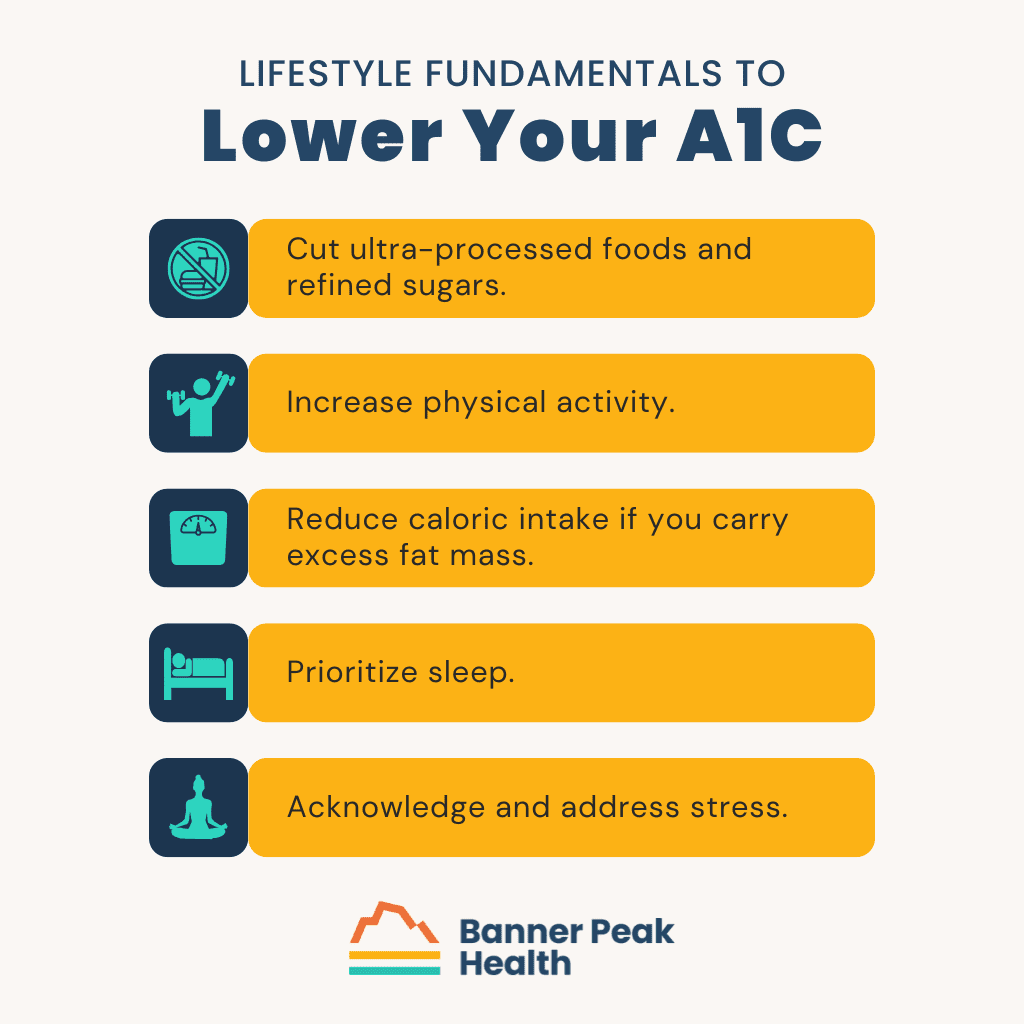
- Cut ultra-processed foods and refined sugars. These spike blood sugar rapidly and offer little nutritional value.
- Increase physical activity. Exercise helps your muscles absorb glucose and improves insulin sensitivity.
- Reduce caloric intake if you carry excess fat mass. Visceral fat directly contributes to insulin resistance.
- Prioritize sleep. Poor sleep disrupts the hormones that regulate blood sugar.
- Acknowledge and address stress. Chronic stress elevates cortisol, which raises blood sugar.
These fundamentals form the foundation of metabolic health. Many people see meaningful improvement in their hemoglobin A1C by applying these principles over several months.
Step Two: Fine-Tune With Real-Time Feedback
If you want to go deeper, a continuous glucose monitor offers a granular view of your individual responses. You’ll learn what foods spike your blood sugar, how timing and food combinations matter, and how exercise and sleep affect your readings.
This is personalized medicine at its most practical. Rather than following generic advice, you learn what works for your body. At Banner Peak Health, we help patients with this kind of data-driven optimization.
Setting Realistic Expectations
Metabolic health unfolds over months and years, not days. You can only meaningfully recheck your hemoglobin A1C every three months, since that’s how long it takes your red blood cells to turn over and reflect your new patterns.
You won’t find a silver bullet for this. If you want to lower your A1C naturally, it requires an integrated approach: better nutrition, more movement, adequate sleep, and managed stress.

Today’s Takeaways
So what is hemoglobin A1C, really? It’s not a verdict. It’s information: a snapshot of where your metabolic health has been over the past three months.
If that number is higher than you’d like, start with the fundamentals in Step One. If you want more precision, consider working with a CGM to understand your body’s unique responses.
At Banner Peak Health, hemoglobin A1C is one of many tools we use to assess and optimize your health. We’re here to help you interpret your numbers and build a personalized plan to improve them.