
For decades, campaigns like “Got Milk?” positioned dairy as a nutritional cornerstone. Today, it’s one of the most controversial topics in nutrition.
So, is dairy good or bad for you? The answer is neither… and both.
Like most nutritional principles, it comes down to moderation. Milk is milk. How we consume it, and how much, determines whether we experience health benefits or health risks.
The Nutritional Case for Dairy
People have been drinking milk for thousands of years. When you examine its nutritional content, the appeal is obvious: It’s nutrient-dense.
A single serving of milk delivers protein alongside an impressive array of vitamins and minerals: calcium, magnesium, potassium, zinc, selenium, vitamins A and B12, and riboflavin. Few other beverages pack this much macro- and micronutrient potential into one glass.
Research supports several health benefits, particularly for low-fat dairy and yogurt. The calcium and protein content (without excessive saturated fat) contributes to better bone health. This matters for osteoporosis prevention and reducing bone degeneration over time.
Some studies suggest links to lower cardiovascular disease risk. And perhaps most notable: Dairy consumption may be protective against colorectal cancer, likely due to increased calcium intake.
The Concerns: Prostate Cancer and Parkinson’s Disease
The primary concerns around dairy center on two conditions: prostate cancer and Parkinson’s disease.
Multiple meta-analyses suggest a modest association between high dairy consumption and prostate cancer risk. One data point: an 11% higher risk of developing prostate cancer for every 400 grams of milk consumed daily, or roughly two cups.
Modern dairy cows are bred to be hyper-producers of milk. This milk contains elevated levels of IGF-1 (insulin-like growth factor 1), a hormone that stimulates growth. In laboratory experiments, IGF-1 promotes the proliferation of prostate cancer cells and can inhibit apoptosis, the programmed death of normal cells.
There’s another proposed pathway: Whey casein protein may boost an enzyme called TOR, which has been shown to accelerate prostate cancer growth.
Association doesn’t equal causation. These findings show a link, not proof that milk causes prostate cancer. The relationship appears dose-dependent: Drinking large quantities increases risk, but moderate consumption likely does not. And if IGF-1 were truly driving cancer development, we’d expect associations with many cancer types, not just prostate cancer.
The same studies that suggest prostate cancer risk also show dairy may be protective against colorectal cancer. The picture is mixed.
The Parkinson’s disease connection is less clear. Studies show a dose-dependent relationship (high milk consumption correlates with increased risk), but researchers don’t understand why. The association isn’t seen with fermented dairy products like yogurt, only with milk itself.
Recent research has identified a strong link between pesticide exposure and Parkinson’s disease. Could pesticide contamination in milk explain the association? It’s speculative, but plausible.
We can’t say with certainty that pesticides cause Parkinson’s, but the connection warrants attention.
Is Dairy Inflammatory?
Many patients ask whether dairy causes inflammation. I searched the medical literature and found no clear data supporting this claim.
Despite what circulates online (advice to avoid milk when you have a cold or are trying to reduce inflammation), the evidence isn’t there.
Understanding Lactose Intolerance
Beyond disease associations, the most common dairy concern is lactose intolerance. It affects a staggering 65–76% of the global population to some degree.
Lactose intolerance is largely genetic. It’s more common in African, Asian, Latino, and Native American populations and far less common in those of European descent. As we age, the enzyme that breaks down lactose (called lactase) becomes less efficient or decreases in quantity.
The symptoms are familiar: abdominal pain, bloating, flatulence, and diarrhea. When lactose isn’t broken down in the small intestine, it passes into the colon. Gut bacteria then ferment it, producing hydrogen gas, the culprit behind the discomfort.
Diagnosis rarely requires formal testing. A therapeutic trial works well: Avoid dairy, see if symptoms improve, reintroduce it, see if symptoms return. If you want to continue consuming dairy, try taking a lactase enzyme beforehand and assess the results.
For those curious about a formal diagnosis, there’s a hydrogen breath test. You consume a lactose load, and clinicians measure hydrogen in your exhaled breath. Elevated levels confirm the diagnosis. But most patients never need this.
Practical Solutions for Dairy Sensitivity
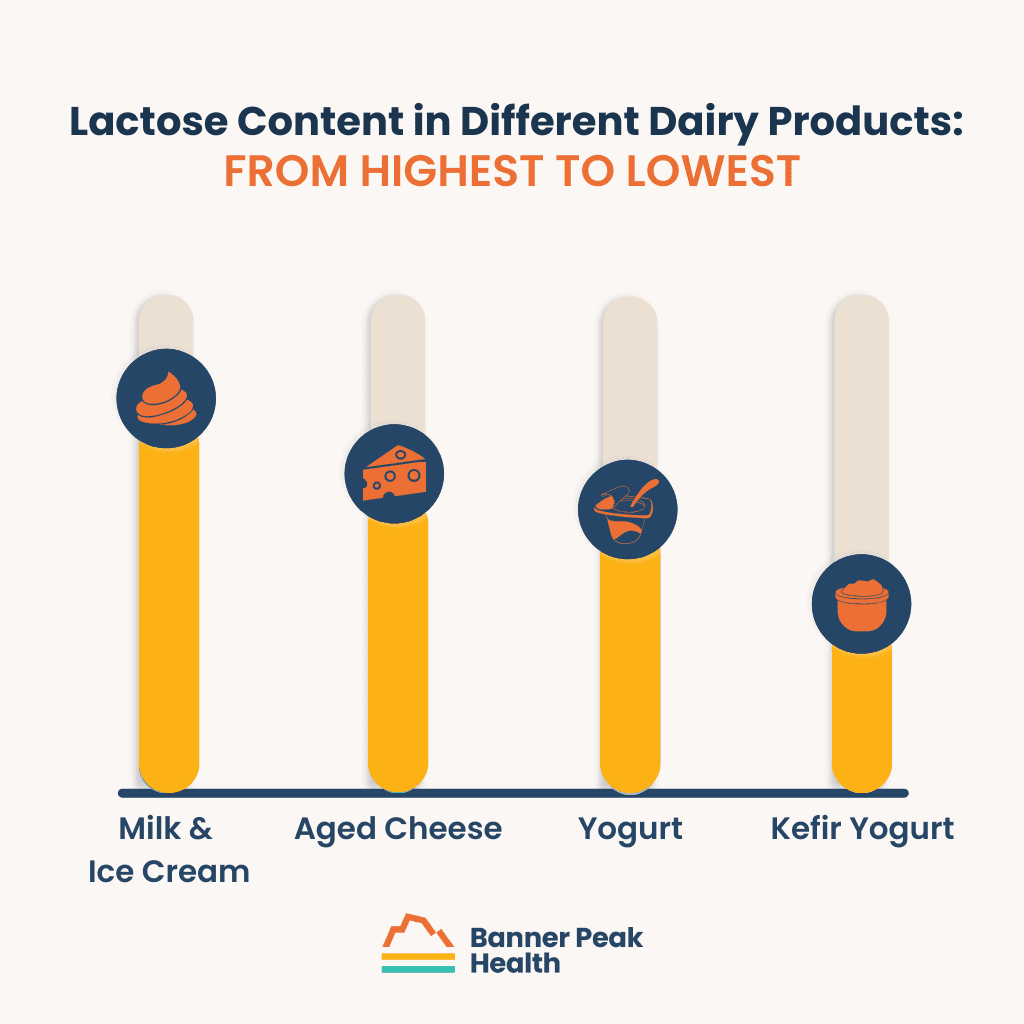
Not all dairy is created equal when it comes to lactose content.
Milk and ice cream contain the highest amounts. Harder, aged cheeses contain less, as the aging process reduces lactose. Yogurt has less than milk, and kefir yogurt has even less than regular yogurt.
If you’re somewhat sensitive (meaning you have reduced but not absent lactase enzyme), you may tolerate aged cheeses, kefir, or yogurt without issue but struggle with milk or soft cheeses. Experiment to find your threshold.
There’s A2 milk, a new option you may have noticed in grocery stores. Milk contains two types of casein protein, A1 and A2. Most commercial milk contains both, depending on cow breeds selected for high milk production. Some people tolerate A2-only milk better, even independent of lactose content.
If you want to keep milk in your diet but experience discomfort, A2 milk is worth trying.
My Approach With Patients
If you feel fine consuming dairy, you don’t have to avoid it.
I’m not opposed to dairy as a way to get adequate calcium and protein. These nutrients matter, and if dairy helps you meet your needs, that’s a reasonable approach, in moderation.
If there were clear data showing that a specific amount of milk caused cancer, I’d advise avoidance. But we’re dealing with associations, not causation, and many other factors contribute to cancer development (genetics being a major player).
If you’re managing cardiovascular risk, lean toward lower saturated fat options. A 0% Greek yogurt delivers the protein and calcium benefits without the saturated fat of whole-milk varieties. That doesn’t mean you can never enjoy full-fat dairy; just be mindful of the balance.
If the data changes, my opinion will change. Nutritional science is difficult to study rigorously. There’s little funding for large randomized controlled trials on food, since no pharmaceutical company stands to profit. Much of the data is observational, with inherent limitations.
I didn’t find strong evidence that dairy is “bad” for you, but I remain open to updating this perspective if new research emerges. That flexibility is how good medicine works.
Is dairy bad for you? Not inherently. Is dairy good for you? It can be. The answer, as with most nutrition questions, lies in moderation and paying attention to how your body responds.