
You can train your nervous system the same way you’d train a bicep: with specific reps, consistent practice, and progressive challenge. I call the drills below “parasympathetic push-ups,” daily reps that strengthen your body’s capacity to recover from stress.
Modern life overwhelms our sympathetic nervous system, the fight-or-flight wiring that primes us for short-term survival. We don’t need help revving that engine; daily stress does it for us. The missing piece is training the parasympathetic system: the network that slows the heart, calms inflammation, and manages our stress response.
The 10 vagus nerve stimulation exercises below are ranked from strongest to weakest evidence, with grades and practical guidance for each. We’ll address HRV as a stress management tool later, including what it can and can’t tell you about progress.
The Vagus Nerve: Your Body’s Weighted Keel
For years, I pictured the autonomic nervous system as a seesaw: sympathetic on one side, parasympathetic on the other, alternating back and forth. I’ve since replaced the seesaw with a sailboat carrying a weighted keel.
Above the waterline, the sail catches wind and drives the boat forward. The wind leans the boat over, and that forward momentum is the sympathetic system doing its job.
Below the waterline, a weighted keel prevents the boat from capsizing. When the wind dies, the keel rights the boat back to vertical.
The keel is the parasympathetic nervous system. Life’s stressors, illness, poor sleep, and trauma all act as wind trying to tip us over.
Successful aging depends on the keel’s ability to right the boat, a process physiologists call homeostasis. We need to strengthen the keel, not just wait for the wind to stop.
The primary highway of the parasympathetic system is the vagus nerve, one of 12 cranial nerves and the longest in the body. It originates in the brainstem, travels through the neck (right next to the carotid artery), and branches into the heart, lungs, stomach, liver, pancreas, kidneys, and intestines.
Vagal activity lowers blood pressure, reduces heart rate, controls digestion, opens the airways, and dials down the body’s inflammatory signaling.
“Vagal tone” describes how strong and responsive the vagus nerve is. The goal of every vagus nerve stimulation exercise is to make vagal tone as buff as possible.
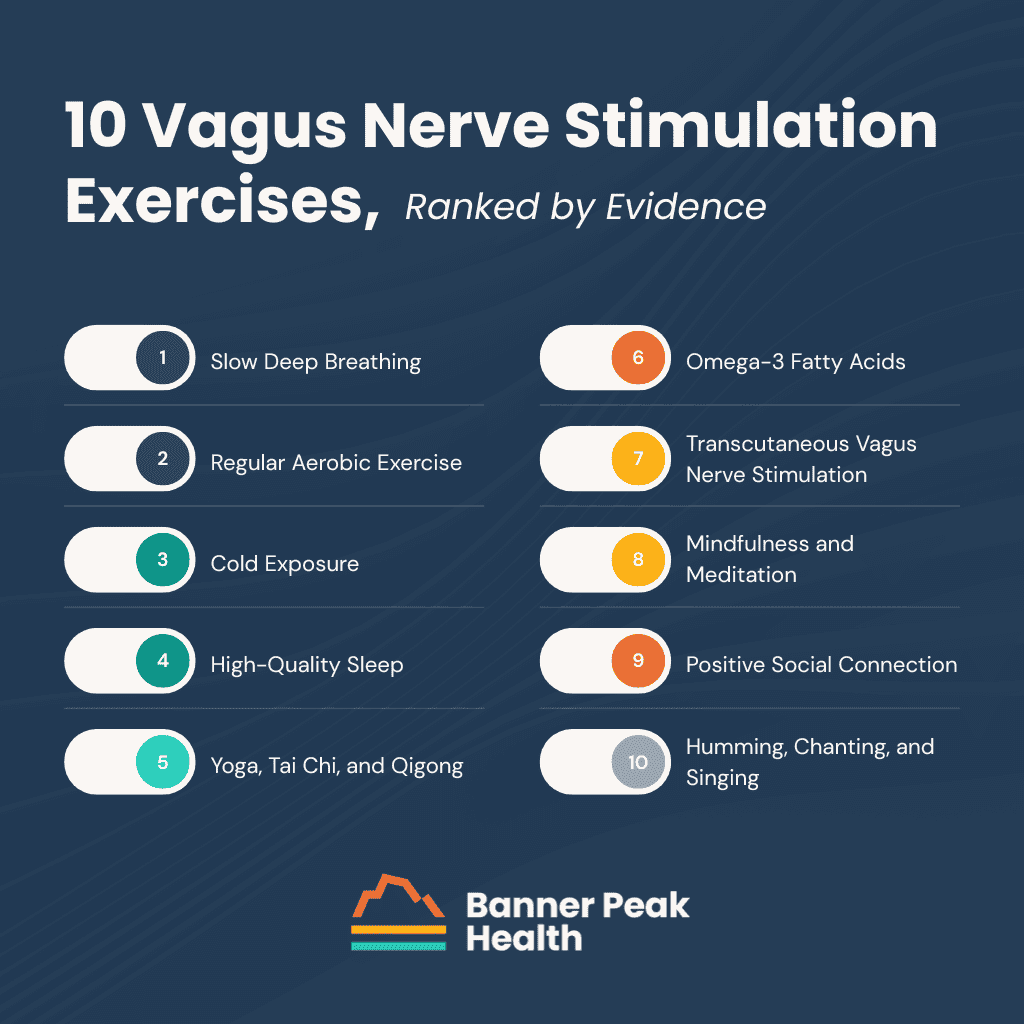
10 Vagus Nerve Stimulation Exercises, Ranked by Evidence
If we were talking about chemotherapy or surgery, we’d demand the strongest possible evidence before proceeding. Every item on the list below is safe, inexpensive, and accessible.
The evidence bar for vagus nerve stimulation exercises can be lower when the risk is near zero and the cost is negligible. Even the entries near the bottom carry almost no downside.
The ranking runs from strongest evidence to most preliminary.
1. Slow Deep Breathing
Evidence: strong.
Breathing at six breaths per minute, five counts in and five counts out, is the simplest and best-supported exercise on this list. The slow rhythm activates the parasympathetic system directly. For a step-by-step protocol, see our guide to belly breathing techniques.
2. Regular Aerobic Exercise
Evidence: strong.
Study after study has documented the value of regular aerobic exercise across almost every health metric we can measure. Improved vagal tone now belongs on that list.
3. Cold Exposure
Evidence: moderate to strong.
Cold water immersion and cold showers create deliberate physical stress. In sailboat terms, cold exposure tips the boat over on purpose so the keel can practice righting itself. Repeated cold challenges train the parasympathetic system to mount a faster, stronger response.
4. High-Quality Sleep
Evidence: moderate to strong.
Quality sleep improves every health metric we have ever measured. Vagal tone is on the list.
If you follow our blog, you’ve heard me say the same about exercise; the overlap between sleep and athletic performance benefits is almost complete.
5. Yoga, Tai Chi, and Qigong
Evidence: moderate.
Yoga, tai chi, and qigong leverage thousands of years of cultural wisdom about the connection between movement and breathing. If human beings have practiced these disciplines for millennia, there’s good reason to think the physiological effects are real. Controlled breathing paired with slow, deliberate movement stimulates vagal activity through multiple pathways at once.
6. Omega-3 Fatty Acids
Evidence: growing.
Research links omega-3 fatty acids to improved cardiovascular and cognitive outcomes. Improved vagal tone may be one mechanism behind those benefits, though researchers are still sorting out whether omega-3s affect vagal tone directly or as a downstream result of other physiological changes.
7. Transcutaneous Vagus Nerve Stimulation
Evidence: moderate but mixed.
The vagus nerve runs through the neck just millimeters below the skin surface, right alongside the carotid artery. The nerve’s proximity to the surface makes it accessible to low-level electrical stimulation delivered through the skin.
Devices like Truvaga deliver targeted pulses in a two-minute, twice-daily protocol. For a deeper look at how Truvaga works and our lending library, see the dedicated post.
8. Mindfulness and Meditation
Evidence: moderate but mixed.
The data on meditation and vagal tone are inconclusive, but the risk-benefit ratio makes the practice an easy recommendation. Meditation costs nothing, carries no risk, and the broader benefits for stress, mood, and focus are well-documented.
9. Positive Social Connection
Evidence: growing.
Humans evolved as social creatures. A person living in isolation is not in his or her optimal evolutionary state.
Research links loneliness with worse psychological and physical health outcomes. Meaningful social connection correlates with better health markers, and improved vagal tone may be one mechanism.
10. Humming, Chanting, and Singing
Evidence: preliminary.
The vagus nerve passes through the larynx, throat, and lungs. The working hypothesis is that vocal vibration provides a mechanical stimulus to the vagal fibers running through those structures, similar to how a transcutaneous device delivers an electrical signal through the neck. Research is early, but the activity carries zero risk and has obvious social benefits.
A Realistic Look at HRV and Vagal Tone
Heart rate variability is the best available proxy for vagal tone. HRV norms vary by age, and population-level data show the metric improves with the exercises above.
At the individual level, the HRV signal is subtle and noisy. For any one person tracking HRV on a Garmin or Oura Ring, day-to-day fluctuations overwhelm any signal from a breathing practice or cold plunge. The statistical benefit of vagal training shows up across populations, not on a single wristband.
Don’t let HRV’s limitations discourage you. The vagus nerve stimulation exercises on this list work through mechanisms HRV can’t capture in real time. Commit to consistent practice and let the benefits accumulate, rather than chasing daily numbers on a screen.
Parasympathetic Rehab at Banner Peak Health
At Banner Peak Health, vagal tone is a clinical priority. We’re building a multidisciplinary parasympathetic rehab program that incorporates vagus nerve stimulation exercises, lifestyle coaching, and the Truvaga lending library.
The lending library lets patients borrow a Truvaga device for a month before committing to a purchase. The protocol is simple: two minutes per side, twice daily. Our approach to concierge medicine gives us the time to walk each patient through the program and adjust it to their needs.
Today’s Takeaways
Vagus nerve stimulation exercises are the parasympathetic push-ups your body needs to stay balanced as you age. The 10 practices above range from well-supported (slow breathing, aerobic exercise) to preliminary (humming and chanting), but every item on the list is safe, cheap, and accessible.
Start with slow deep breathing at six breaths per minute. Stack additional practices as they fit your routine. And if you’re interested in athletic performance after 50, consider how parasympathetic training fits alongside the strength and endurance work you’re already doing.
At Banner Peak Health, we help patients build a personalized parasympathetic rehab program. If vagal tone or the Truvaga lending library interests you, bring it up at your next visit.