The United States has over 100,000 dietary supplements on the market, and the FDA doesn’t regulate them for safety or purity unless a product causes enough harm to force action.
What used to be word-of-mouth recommendations from a friend has become a tsunami of social media advice with no legitimacy, no evidence, and a tremendous profit motive. Even I, a physician who doesn’t spend my days scrolling through feeds, can’t avoid the ads, the posts, and the questions from patients about the latest pill or powder.
One supplement getting attention is vitamin K2. Before we can weigh vitamin K2 benefits, we need to understand what K2 is, what the research says, and how to make safe choices with supplements in a market designed to confuse you.
What Is Vitamin K2? A Brief History
The “K” in vitamin K comes from the German word “Koagulation,” meaning blood clotting. In 1929, a Danish biochemist named Henrik Dam observed that chickens fed a fat-deficient diet developed spontaneous bleeding.
Science looked different 100 years ago. Dam stared at chickens, noticed they were hemorrhaging, and isolated a fat-soluble nutrient responsible for clotting.
By 1935, Dam had identified and named this nutrient vitamin K. He went on to win a shared Nobel Prize in 1943 for the discovery.
Vitamin K is a cofactor necessary for proteins that run processes in our bodies. The two major classifications are K1 and K2, divided by their natural sources and where they act in the body.
K1 comes from green leafy vegetables: kale, spinach, and similar greens. Once ingested, K1 travels straight to the liver, where it activates proteins in the clotting cascade. Without adequate K1, your blood can’t clot, which is what Dam observed in his chickens.
K2 comes from animal sources (meat, eggs, dairy) and from bacteria in the gut. Instead of heading to the liver, K2 travels through the bloodstream and acts on bones and blood vessels.
K2 helps deposit calcium into bones to keep them strong and helps keep calcium out of blood vessel walls to reduce your risk of hardening of the arteries. These two functions drive the interest in vitamin K2 benefits.
Vitamin K2 Benefits: What the Research Shows
We know K2 acts on bones and blood vessels. But does supplementing with K2 produce measurable health improvements? The evidence is mixed.
Vitamin K2 Benefits for Bone Density
Bone density is the strongest case for vitamin K2 benefits. Studies have found K2 supplements can produce a marginal increase in bone mineral density.
The catch: No study has demonstrated K2 supplements reduce the risk of fractures, which is what we care about for resistance training for longevity and keeping our bones healthy.
One exception is a group of Japanese trials using K2 at prescription-strength doses many times higher than any over-the-counter supplement. Those trials may have shown some benefit, but they weren’t testing a supplement. They were testing a dosage high enough to function as a pharmaceutical intervention.
Vitamin K2 Benefits for Arterial Calcification
Arterial calcification, the hardening of the arteries known as atherosclerosis, is a risk factor for stroke and heart attack. One trial in diabetic patients with cardiovascular disease did not show a clear benefit. Conflicting studies prevent any consensus on K2’s role here.
Vitamin K2 Benefits for Heart Health
The ultimate test for any cardiovascular supplement is whether it reduces risk of a heart attack or stroke. For K2, no study has demonstrated a reduction in these hard outcomes. The biology is plausible, yet vitamin K2 benefits for heart health lack clinical proof in the form of reduced cardiac events.
The Vitamin D and K2 Pairing
K2 comes packaged with vitamin D on most supplement shelves. The theory has biological plausibility: Vitamin D helps your gut absorb more calcium, and K2 directs calcium into your bones instead of your artery walls.
The logic is appealing, but no clinical trial has proven the pairing delivers better outcomes. That’s how it’s packaged anyway.
Four Rules for Evaluating Vitamin K2 Benefits (or Any Supplement)
Vitamin K2 is one of over 100,000 supplements on the market, and making rational decisions in this chaotic space requires a system. At Banner Peak Health, we apply a four-rule framework to every supplement that crosses our desk.
Rule #1: It Has to Be Safe
A supplement must have no documented danger and no plausible biological pathway to a dangerous outcome. Some supplements were so hazardous the FDA had to step in.
In 2004, the FDA banned dietary supplements containing ephedra for increasing the risk of heart attack and stroke. Until then, anyone could buy it over the counter.
The peptide craze falls flat under this rule. Unregulated products injected into your body carry risks of contamination, adulteration, and infection, and some have biological pathways to increased cancer risk. If a supplement can’t clear the safety bar, no amount of promised benefit matters.
Rule #2: It Can’t Be Too Expensive
The more a supplement costs, the greater the burden to prove it works. People can spend hundreds or thousands of dollars per year on exotic formulations. A $5-per-month supplement with modest evidence is a different calculation than a $200-per-month product with the same evidence.
Rule #3: Documented or Plausible Biological Benefit
A supplement needs either clinical evidence of benefit or a strong biological reason to believe it works. Fish oil supplements have documented reductions in cardiac events for people with low omega-3 levels.
Vitamins D and B12 are cofactors in hundreds, if not thousands, of biological pathways, and documented deficiencies can disrupt those pathways. This rule separates substances with scientific backing from social media hype.
Rule #4: A Titratable Endpoint
A supplement needs a way to prove it’s working. You need either a measurable biological marker, such as a lab value, body composition or bone density, or blood pressure.
The alternative is feeling a noticeable difference. If you can’t track it and you can’t feel it, you have no way to confirm the supplement is working.
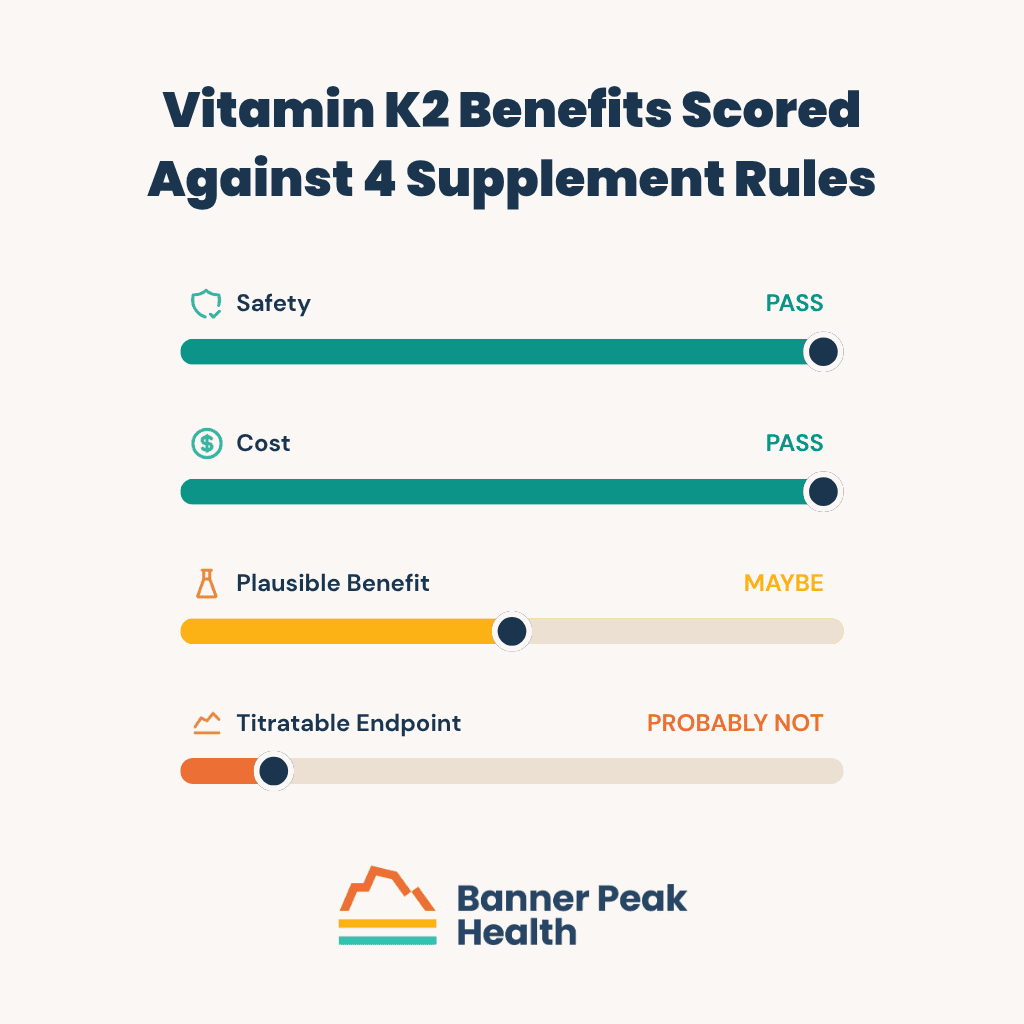
How Vitamin K2 Benefits Measure Up Against the Four Rules
Now we run vitamin K2 through the framework.
Safety: Pass
Vitamin K1 and K2 are fat-soluble. Other fat-soluble vitamins like A and D can build up to toxic levels, but vitamin K doesn’t share that risk. K2 has an excellent safety record.
One caveat: Warfarin, an older blood thinner, works by inhibiting vitamin K. If you take warfarin, supplementing with K2 could counteract your medication.
Talk to your doctor about your heart health risk factors before adding K2 to your routine.
Cost: Pass
K2 supplements cost between $5 and $20 per month. The price clears this bar with room to spare.
Plausible Benefit: Maybe
No clinical study has demonstrated hard endpoints: fewer bone fractures, fewer heart attacks, fewer strokes. The biological plausibility is reasonable. K2 activates proteins involved in calcium metabolism in bones and blood vessels.
The science makes sense on paper, but it hasn’t translated into proven outcomes.
Titratable Endpoint: Probably Not
No routine blood test measures K2 levels, so you can’t diagnose a deficiency or confirm you’re replacing it. No study shows a clear change in a biological endpoint like fracture reduction or coronary calcification.
You won’t feel different taking it. The effects are too subtle to notice.
Running vitamin K2 benefits through our four-rule framework lands us in a gray zone: safe and cheap, but unproven and unmeasurable.
Who Might See Vitamin K2 Benefits?
Most people get adequate K2 from meat, eggs, and dairy products in their diet. Without a blood test to confirm a deficiency, the claimed vitamin K2 benefits don’t justify recommending supplementation to the general population.
A narrow use case does exist. A vegan with documented low bone density might benefit from K2 supplementation: A strict vegan diet lacks the primary dietary sources of K2, creating a theoretical deficiency.
The risk-benefit calculation in that specific scenario favors trying it, but that’s a personalized decision, not a blanket recommendation.
K2 is overhyped. The evidence doesn’t support supplementation for most people.
Today’s Takeaways
Life isn’t yes or no. Life is shades of gray, and making medical decisions around “maybe” requires a structured approach.
The four-rule framework we use at Banner Peak Health helps us cut through the noise and evaluate vitamin K2 benefits, or any supplement’s benefits, with intellectual rigor instead of marketing hype.
K2 is safe, K2 is cheap, and the biology is plausible. But the evidence for hard clinical outcomes is thin, and we have no way to measure whether it’s working.
For the average person eating a balanced diet, K2 supplementation isn’t necessary.
For someone with a specific deficiency or risk profile, the conversation changes. That’s the kind of personalized risk assessment we do here at Banner Peak Health: figuring out how complex medical decisions apply to you as an individual.