
As humans, we’ve evolved in response to our physical environment. I’ve written about circadian rhythms and how sleep affects athletic performance. Our biology has adapted to the 24-hour solar day, but it has adapted to a second, less appreciated force, too: gravity.
The consequences of removing gravity show up fast. During long-term stays on the International Space Station, astronauts lose bone mass in space at 1% to 2% per month in weight-bearing areas. On Earth, that rate is about 0.5% per year.
The result is a dangerous, accelerated osteoporosis. Astronauts often don’t fully recover their bone density after returning home.
Lack of gravitational stimulus is one of the most potent factors behind that bone loss. Can we apply what we know about physiology and physics to improve our health? That’s the premise behind vibration plate benefits, and the answer isn’t as simple as TikTok makes it look.
Why Gravity Matters for Your Bones and Muscles
Bone cells contain mechanoreceptors that directly perceive gravitational force. When those receptors stop detecting gravity, the cells respond by thinning the skeleton. Bone resorption outpaces bone formation, and density drops.
Muscles follow a related pattern. Our muscles attach to bones through tendons and ligaments, and the contractions we use to move our body mass against gravity maintain both muscle strength and bone integrity. The muscle contractions that move your body against gravity provide traction signals to bone, which is why resistance training for longevity works.
Remove gravity, and both systems deteriorate. Increase the gravitational load, and both grow stronger. This relationship between gravity and tissue health is the physiologic principle that vibration plates aim to exploit.
What Is a Vibration Plate?
A vibration plate is a platform you stand on that oscillates at 20–40 hertz, or 20–40 times per second. You stand or squat on the plate, and the rapid oscillation forces your body to react to each subtle shift in position.
A standard barbell curl exercise illustrates how vibration plate benefits work at the muscular level. As you curl the weight upward, your bicep fibers shorten under load. That’s a concentric contraction.
When you lower the weight in a controlled motion rather than dropping it, your muscle fibers lengthen under resistance. That’s an eccentric contraction.
Both types of contraction are vital stimuli for maintaining muscle. A vibration plate compresses this cycle: each oscillation forces weight-bearing muscle groups throughout the body to concentrically and eccentrically contract in rapid succession.
The physiologic benefits are increased blood flow to muscles and skin, greater muscle activation, and a bone-strengthening traction stimulus. For anyone interested in athletic performance after 50, the question isn’t whether the stimulus exists. The question is how much it matters.
How Much Do Vibration Plate Benefits Matter?
So, do vibration plates work? The short answer: yes, but the magnitude of benefit is modest.
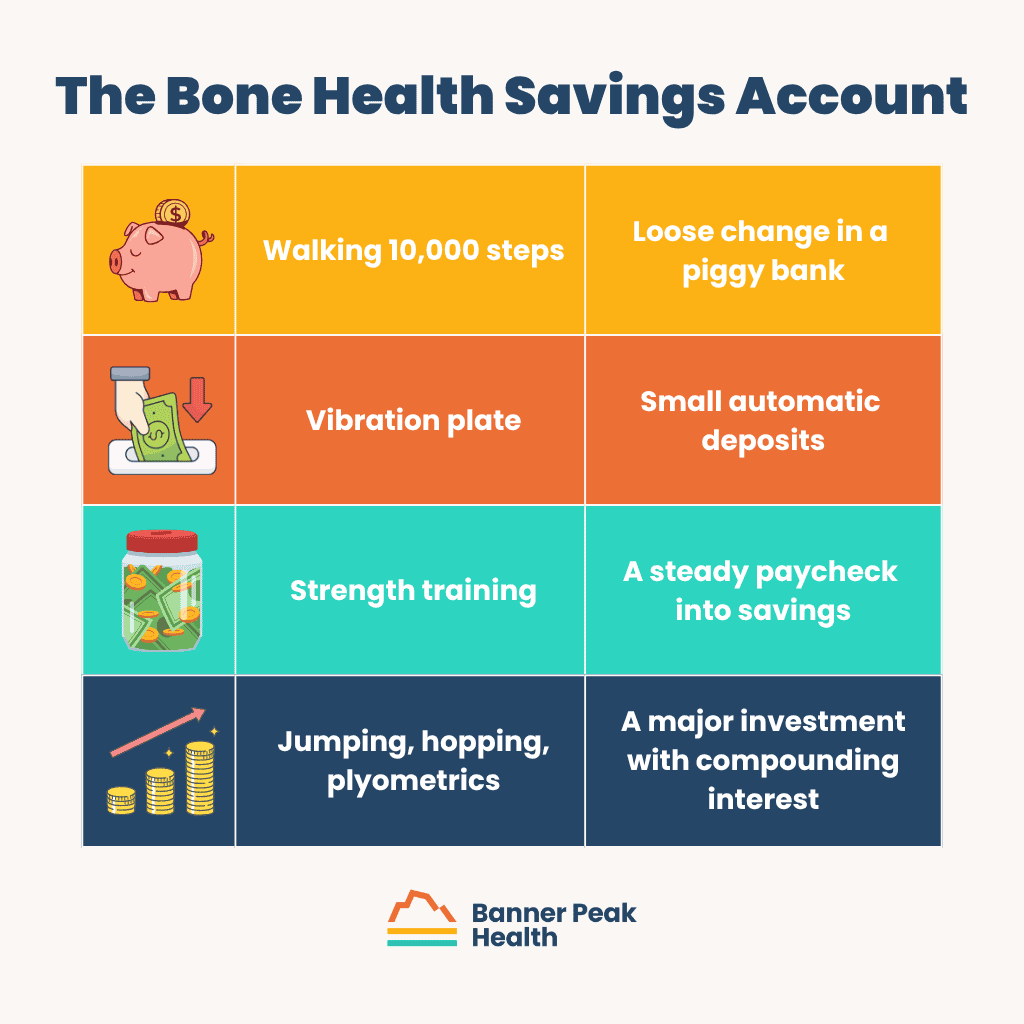
Bone health is like a savings account, and the goal is to keep the account solvent for a lifetime. The impact of walking 10,000 steps a day is the equivalent of tossing loose change into a piggy bank. A vibration plate steps that up to small, regular automatic deposits.
Strength training, moving more than your body’s own mass against gravity, is a steady paycheck going straight into savings. High-impact exercise (jumping, hopping, plyometrics) is a major investment with compounding interest.
On that spectrum, vibration plate benefits land toward the bottom: real, documented, but meager. The physiologic basis is sound, and studies confirm improvement in both muscle activation and bone density. For anyone who can walk and lift weights, conventional exercise delivers a far stronger stimulus.
Who Gets Real Vibration Plate Benefits?
The protocols behind FDA-approved vibration plates call for about 10 minutes of use, twice a day. The demonstrated benefits cover two outcomes: muscle activation and bone density.
For anyone with the physical ability to walk or perform resistance training, those activities provide a much stronger stimulus. Resistance training for women and men alike outperforms vibration therapy for preserving bone and muscle.
The genuine use case for vibration plate benefits is narrow: people who are frail, deconditioned, or mobility-limited and can’t tolerate the demands of conventional exercise. People with sarcopenia (age-related muscle loss) or severe deconditioning may find a vibration plate to be a viable starting point.
One critical warning: The consumer-grade vibration plates all over TikTok and Instagram don’t follow FDA-approved protocols. These products have no proven benefit and can deliver stimuli strong enough to cause harm.
Vibration Plate Benefits, Side Effects, and Social Media Myths
Whole-body vibration that’s too strong or applied too long can cause inner ear disturbances, skeletal stress, and digestive problems.
Vibration plates are contraindicated for people with kidney stones (the oscillation can dislodge them), pregnant women, and those with a history of blood clots, recent fractures, recent eye surgery, or uncontrolled vertigo. Talk to your physician before trying a vibration plate.
Social media has pinned a long list of unproven claims to vibration plates: fat burning, weight loss, detox, lymphatic drainage, cellulite reduction. No physiologic argument or clinical evidence supports any of these claims about vibration plate benefits. The same scrutiny that applies to making safe choices with supplements applies to vibration plates.
Osteoboost: An FDA-Approved Pelvic Vibration Device
One FDA-approved product takes a different approach to vibration therapy. Osteoboost isn’t a standing plate. The device wraps around the pelvic area like a girdle and delivers vibration directly to the hip bones.
Osteoboost targets postmenopausal women with osteopenia (early-stage bone thinning) who prefer to avoid medication. Daily use has shown modest improvement in bone density, but Osteoboost doesn’t rebuild bone; the device slows and prevents further loss. Women with more advanced osteoporosis or preexisting fractures need a stronger intervention.
For postmenopausal women weighing their options, bone density conversations often overlap with decisions about hormone replacement for perimenopause and other evidence-backed treatments.
Today’s Takeaways
Have you ever eaten alligator, snake, or frog legs? Every exotic meat gets the same review: “Tastes like chicken.” Why not skip the gator and just eat the chicken?
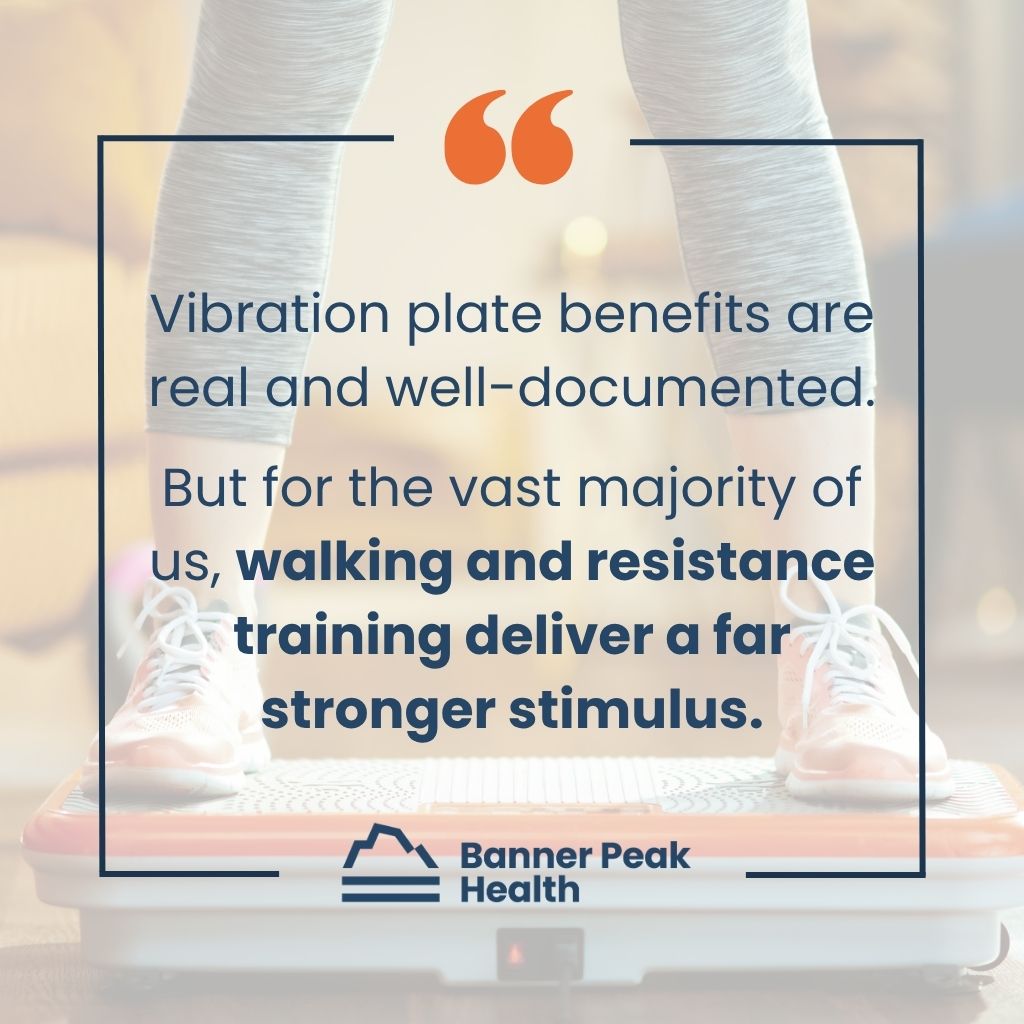
Vibration plates are the gator of the exercise world. The vibration plate benefits are real and well-documented. But for the vast majority of us, the chicken is right there: walking and resistance training.
The use case for vibration plates is narrow. People who are frail or mobility-limited and can’t perform conventional exercise may find genuine value in an FDA-approved device. Everyone else can skip the exotic option and stick with what works.
At Banner Peak Health, we bring healthy skepticism to every new health trend. We look at the evidence and match patients with the tools that fit their needs. If you’re curious about vibration plates or any other trending claim, reach out to our team.