
“In the land of the blind, the one-eyed man is king.”
This adage comes to mind whenever I think about cancer screening. A few years ago, I introduced Banner Peak Health patients to the GRAIL Galleri test, a screening technology so advanced it would’ve been unimaginable when I was in medical school in the 1980s. This spring, the NHS-Galleri study released its three-year results, and the headlines weren’t kind.
Some proclaimed the test had failed. Declaring failure misses the point.
What follows is my reading of the evidence, why I’m not discouraged, and why Banner Peak Health continues to recommend screening to appropriate patients.
A Blind Spot in Cancer Screening
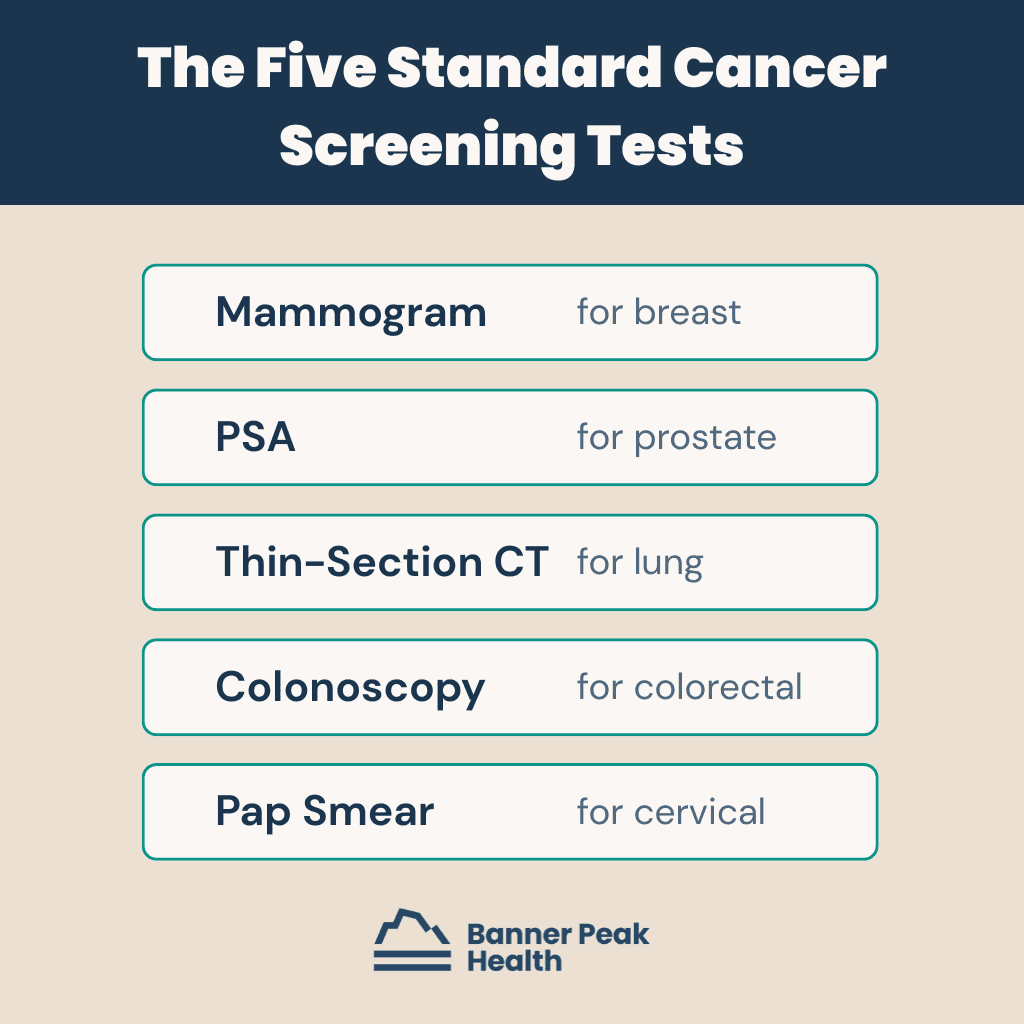
We have established, evidence-based screening guidelines for only five cancers: breast, prostate, lung, colon, and cervical. Five. That’s it.
The five cancers with screening guidelines aren’t even the most lethal. Pancreatic cancer, ovarian cancer, liver cancer, stomach cancer, and dozens of others have no routine screening at all. Physicians and patients are blind to these diseases until symptoms appear, and by then the cancer is often advanced.
The Galleri test is the one-eyed man. It’s imperfect, but it offers a way to screen for cancers we’ve never had a tool to detect.
How the Galleri Test Detects Cancer
Before we talk statistics, I want to put the science in context.
We already encourage our members to stay current on their bloodwork. Galleri adds cancer screening to the routine blood draw.
Cells throughout our bodies constantly die and regenerate. As each cell dies, it releases fragments of DNA into the bloodstream, where they circulate for a few hours before the body breaks them down. At any given moment, billions of DNA fragments from millions of dying cells flow through our blood.
Cancer cells, driven by abnormal biology, grow and die faster than healthy cells. Their faster turnover floods the bloodstream with cancer-derived DNA. These cancer fragments carry a distinct chemical signature: a pattern of methylation (methyl groups attached to the DNA) that flags them as cancerous and, in most cases, pinpoints the anatomical site of origin.
A Galleri screening draws several vials of blood and sifts through billions of fragments to find the handful from cancer. Its sensitivity reaches 76.3% across all stages for the 12 deadliest cancers, the ones responsible for two-thirds of cancer deaths in the United States. Its specificity sits at 99.5%.
In practical terms, for every 200 people screened, about two will test positive. One will be a true positive; the other a false alarm.
The Galleri test gets more accurate as cancers get more aggressive. Traditional screening tools like mammograms and PSA tests tend to catch slow-growing, indolent tumors that may never kill the patient.
Nastier cancers divide faster, shed more DNA, and produce a stronger signal. The test catches the tumors most likely to end a life.
What the NHS-Galleri Study Actually Found
The NHS randomized 140,000 participants into two equal groups. Half received annual screening for three years; the other half continued standard care. The primary endpoint was a reduction in combined stage three and four cancer diagnoses.
Researchers chose cancer stage at diagnosis as a surrogate for what they wanted to know: can screening save lives? Proving a mortality benefit would have required far more participants and many additional years of follow-up.
The study didn’t meet its primary endpoint. Researchers found no statistically significant reduction in combined stage three and four cancers across the full three-year period. The press declared the test had failed.
The Galleri test’s sensitivity and specificity improved over prior data, and by year three, the screened group showed a statistically significant drop in stage four diagnoses. Stage four is the deadliest category. A reduction in stage four diagnoses signals the test may catch aggressive cancers before they advance to their worst form.
The NHS-Galleri findings didn’t produce a definitive verdict. They gave us a refined estimate of probability. For those of us committed to reducing our cancer risk by every available means, does the probability of benefit justify action?
How Certain Do You Need to Be About the Galleri Test?
We live in a culture that wants clean answers. Is the test good or bad? Does it work or not?
Medicine rarely deals in good-or-bad binaries. I make probabilistic assessments every day. When a patient presents with chest pain, I don’t wait for certainty before ordering tests.
I estimate a probability, and once it crosses a threshold, I act. The same logic applies to interpreting the NHS-Galleri data and to the executive physicals we perform at our practice. Whether to use the Galleri test comes down to probability, not certainty: has the evidence crossed your personal threshold for action?
The threshold for action depends on who’s making the decision.
My threshold is low. My mother died at age 60 from metastatic breast cancer. I watched my father go from bike-commuting to a full-time dental practice at 70 to dead from pancreatic cancer in under a year.
I ordered my first Galleri screening the moment it became available. Every year, when I get a negative result, I know the test had about an 84% chance of catching pancreatic cancer if I had it. A negative Galleri result matters.
Medicare or the NHS must weigh Galleri’s potential benefit against population-level costs. Billions in testing, follow-up imaging, and specialist referrals pull dollars from other health care priorities. Government agencies are right to demand a higher standard of proof before spending at that scale.
Individual and institutional perspectives aren’t contradictory. They reflect different thresholds, grounded in distinct responsibilities. A government program can rationally decline to fund widespread adoption at this stage of evidence.
A patient sitting in my office, with a concerning family history, can rationally choose to screen today. Both decisions can be correct.
Today’s Takeaways
The NHS-Galleri study didn’t deliver the clean failure some headlines claimed. The study produced mixed results that look better or worse depending on your perspective.
The Galleri test’s sensitivity remains strong, particularly for the deadliest cancers, and its 99.5% specificity keeps false positives rare. Aggressive, fast-growing malignancies produce a stronger signal than indolent ones. For individual patients weighing risk and benefit, the test has earned its place in a cancer screening plan.
At Banner Peak Health, our concierge medicine model gives us the time to discuss whether Galleri screening is right for each patient. For patients who can manage the out-of-pocket cost and accept a false positive rate of one in 200, the test remains a good investment in long-term health. If you’re wondering whether multi-cancer screening makes sense for you, bring the question to your next visit.